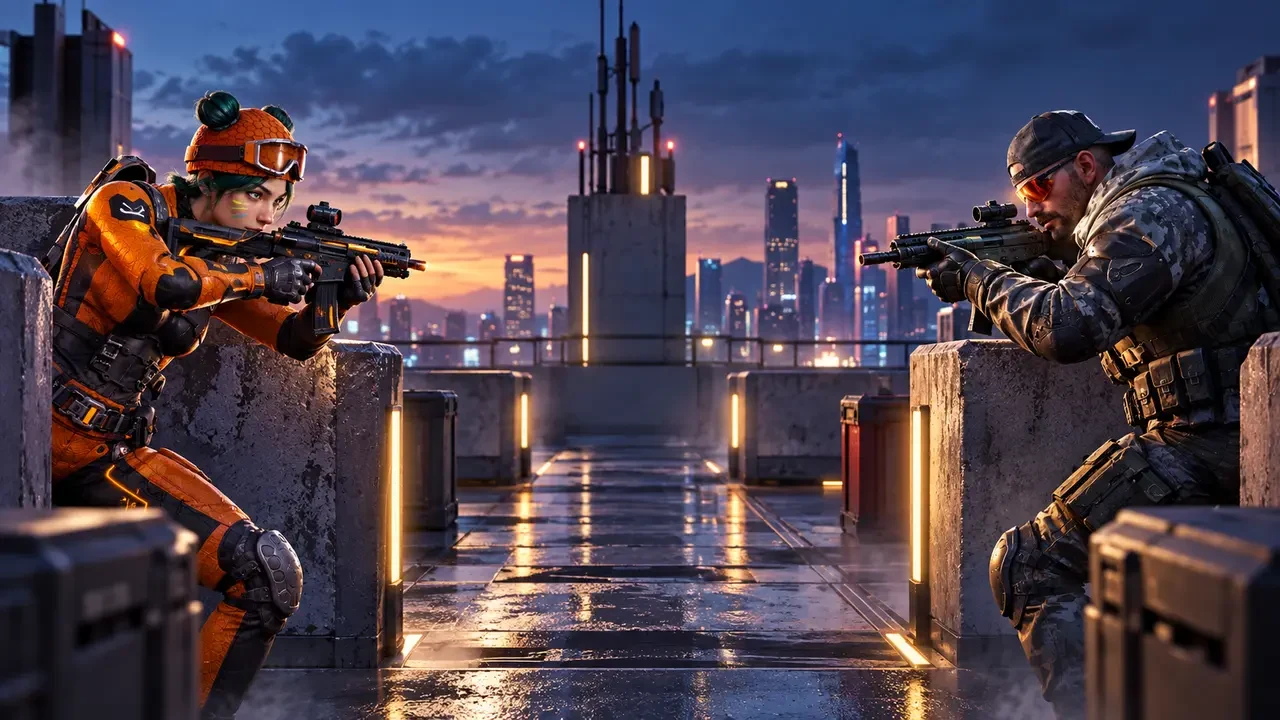
Blood Strike’s Duel mode strips the fight down to a narrow arena, repeated head-to-head rounds and direct gunplay. This guide explains the confirmed format and turns it into a practical routine for aim, cover use, tempo and adaptation.
What Blood Strike Officially Confirms About Duel
Blood Strike introduced Duel in its September 1, 2026 version update. The official announcement describes it as a fast-paced, multi-round head-to-head mode on a narrow battlefield. A player wins by reaching five round wins first, or by holding more round points after all nine rounds are completed.
The same announcement identifies Apex Arena as the exclusive Duel map. It is described as a minimalist arena on the top floor of a high-rise, built for players to practise gunplay. Those confirmed rules shape this guide: every round produces information, the compact space rewards repeatable mechanics, and the format gives you time to adjust instead of treating every loss as final.
The advice below is tactical interpretation rather than hidden game data. Use it to structure practice, then adapt to the weapons, settings and opponent behaviour you actually encounter.
Treat the First Round as a Controlled Test
The opening round matters, but it also gives the clearest chance to learn. Avoid using every trick immediately. Start with a stable route, a familiar firing rhythm and a disciplined first peek. Watch whether the opponent rushes the centre, waits behind cover, changes elevation or repeatedly challenges the same angle.
Collect three details: where first contact happens, how quickly the opponent fires and where they move after taking pressure. Even if you lose the round, this information can improve the next several rounds.
Do not confuse testing with passivity. Hold a position that lets you respond and use cover. A test round should remain competitive; it simply prioritises reliable information over a desperate surprise play. When the round ends, describe the opponent in one sentence: aggressive opener, patient holder, wide mover or reactive counter-peeker.
Build a Repeatable Opening Route
A narrow arena makes movement predictable when players always choose the most direct line. Create two or three opening routes rather than improvising a completely new path every round. One can prioritise early cover, another can create a wider angle, and a third can delay first contact.
A repeatable route lets you compare results. If the same opening fails twice for the same reason, change it. If it creates a favourable first shot but you miss, the route may be sound while the execution needs work.
Avoid sprinting through exposed space without a purpose. Move to the next cover, prepare the crosshair and listen for the opponent’s timing. Small differences in arrival time can change which player is ready first. The strongest route is not necessarily the fastest; it delivers you to a useful position with enough control to take the engagement.
Use Cover Without Becoming Predictable
Cover protects you only while the opponent is uncertain about your next exposure. Repeating the same side, height and timing turns protection into a predictable target. Alternate the peek side, change how long you wait and occasionally reposition before reappearing.
Keep most of the character model protected when checking a lane. Expose only what is necessary to gather information or fire. After shooting, return to cover instead of remaining visible to confirm an uncertain result.
Do not stay trapped behind one object when the opponent has gained the better angle. If safe movement is available, reset to another position and force a new decision. The aim is to make the opponent solve changing problems while your own movement remains deliberate. Random movement is not the same as unpredictable movement; every change should improve information, cover or firing position.
Crosshair Placement Wins Time
Duel compresses the distance between seeing an opponent and taking damage. Crosshair placement reduces the correction needed after the target appears. Keep the crosshair near the likely point of exposure rather than centred on empty floor or sky.
Use the previous round to refine the height and side of the expected peek. If the opponent repeatedly challenges from one cover edge, pre-position for that edge but remain ready to adjust. Do not lock so tightly onto one point that a wider swing defeats your vision.
When moving between positions, guide the crosshair through the dangerous lane first. Arrive with the weapon prepared rather than turning after reaching cover. Smooth preparation is more consistent than a dramatic flick. Over a multi-round match, small reductions in correction time can create several stronger first-shot opportunities.
Control the Rhythm of Each Engagement
Some opponents fire immediately whenever they see movement. Others wait for a clearer target. Change the rhythm so they cannot rely on one response. A quick information peek can draw a shot; a delayed return may catch them resetting. A patient hold can punish a player who expects another instant challenge.
Do not repeat rapid peeks simply because the first almost worked. Each exposure carries risk. After contact, decide whether to re-peek, relocate or wait based on health, cover and the opponent’s last action.
Keep the plan simple under pressure. Before exposing, know where you will return. Before pushing, know which cover you will use next. Duel rewards fast choices, but fast choices improve when the options were considered before the fight. Tempo should come from preparation, not panic.
Adapt After Every Two Rounds
A multi-round format rewards players who update their plan. After two rounds, pause mentally and identify the main pattern. Are you losing the first shot, losing after a good opening, or being surprised by repositioning? Each problem needs a different adjustment.
If the opponent sees you first, change the route or peek timing. If you shoot first but lose, focus on recoil control, burst length and returning to cover. If the opponent escapes and attacks from another angle, improve tracking rather than chasing blindly.
Change one major variable at a time. Altering the route, sensitivity approach, firing rhythm and weapon plan simultaneously makes the result difficult to read. A controlled adjustment gives you evidence. If it works, keep it until the opponent responds. If it fails, return to the stable baseline and test a different answer.
Protect a Lead Without Playing Afraid
Because the official format awards the match to the first player reaching five rounds, every successful round moves you closer to a clear finish. When leading, avoid unnecessary high-risk experiments. Continue using the actions that created the advantage, while expecting the opponent to become less predictable.
Protecting a lead does not mean hiding without information. Maintain a useful angle, control the space around cover and make the opponent reveal their adjustment. If they begin rushing, prepare a stable defensive response. If they slow down, avoid giving away a free angle through impatient movement.
When behind, do not attempt to recover every lost round at once. Win the next decision: better opening cover, cleaner first shot or smarter reset. The nine-round structure provides room for adaptation until someone reaches the winning condition. Calm recovery is more reliable than forcing a spectacular play.
Create a Practical Duel Loadout Routine
Use equipment you can control consistently. A Duel practice session is most useful when the weapon choice supports the skill being trained. For crosshair placement, use a familiar setup that does not distract you with constant adjustments. For recoil practice, choose a configuration that makes mistakes visible without feeling uncontrollable.
Do not copy a loadout only because another player wins with it. Device size, frame rate, touch layout and personal sensitivity affect execution. Test changes in small steps and keep notes on what improved first-shot accuracy, follow-up control and movement.
Before entering, check that the fire, aim, crouch, jump and weapon controls are reachable without blocking the centre of the screen. The September update also mentions a no-ADS turning sensitivity option for TPS, but Duel practice should use settings relevant to the perspective and mode you are actually playing. Avoid applying one setting universally without testing.
Use Duel as a Short Training Block
Apex Arena is officially presented as a place to hone gunplay, so use it deliberately. Begin with a short warm-up focused on smooth aim and controlled movement. Then play several matches with one objective, such as first-contact discipline, cover timing or opponent tracking.
Record outcomes by cause rather than only wins and losses. Useful notes include “crosshair too low,” “re-peeked same side,” “moved without cover” or “adapted after two rounds.” These observations produce actions for the next session.
Finish with a cooldown match using the complete routine: stable opening, information gathering, purposeful cover changes, clean firing and round-by-round adaptation. Stop if your inputs become rushed or inconsistent. Focused practice builds clearer habits than playing many rounds without reviewing why each engagement was won or lost.
Duel Match Checklist
Before the first round, confirm comfortable controls and a familiar setup. In round one, test a stable route and observe the opponent. Track the first-contact position, firing speed and escape direction. Keep the crosshair near likely exposure points and return to cover after shooting.
After two rounds, identify one repeated problem and change one variable. Alternate peek timing and cover side without moving randomly. When leading, preserve the reliable plan while watching for a desperate adjustment. When behind, focus on the next clean decision rather than the entire score.
After the match, review the cause of each loss and choose one practice goal. The official rules make Duel a compact race to five round wins, with total round points deciding the result if all nine rounds are played. Consistency, observation and controlled adaptation are therefore as important as raw aim.
Verified Sources
The Duel rules, Apex Arena description and September gameplay adjustments come from Blood Strike’s official Version Update Announcement dated September 1, 2026. The official website and news index were checked on September 22, 2026.
Top Up Your Favourite Games
If you're looking for a trusted place to top up your favourite games including Free Fire, PUBG Mobile, Mobile Legends, Blood Strike, and Call of Duty, visit HTGTopUp.com for fast digital game top-up services. Website: https://htgtopup.com.