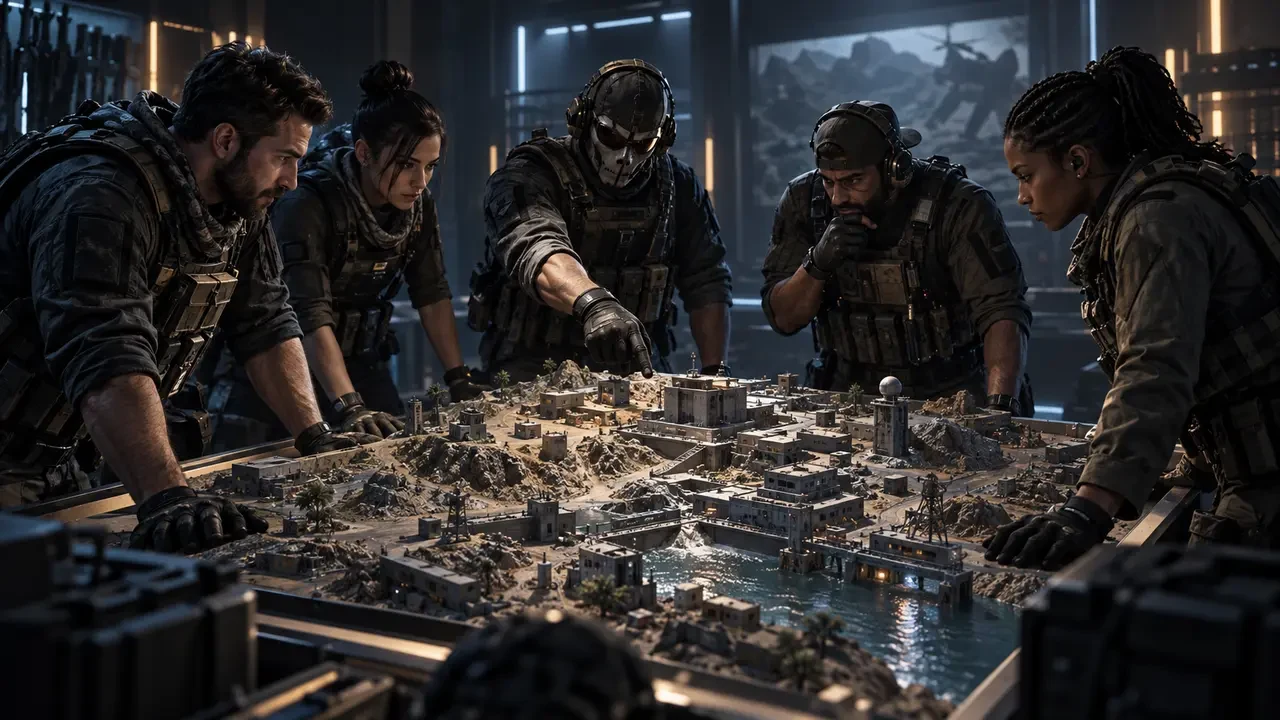
Call of Duty: Mobile’s official 2026 esports settings turn map preparation into a season-long skill. Competitive series use Hardpoint, Search and Destroy, and Control, with a defined map pool and a structured veto process. A team that understands only gunfights can still lose before the lobby begins if its bans, picks, starting sides, and role assignments are poorly prepared.
This guide explains the current official map pool, the best-of-five mode order, the veto sequence, unique Operator Skill rule, weapon-class roles, and a practical training plan. The settings page can be changed by Tournament Administration in exceptional circumstances, so teams should verify it before every official match rather than relying on an old screenshot.
The Official 2026 Esports Map Pool
The official settings divide 13 maps across three competitive modes. Hardpoint has five maps: Summit, Hacienda, Combine, Takeoff, and Arsenal. Search and Destroy has Tunisia, Firing Range, Coastal, Slums, and Meltdown. Control has Raid, Standoff, and Crossroads Strike.
| Mode | Official maps | Pool size |
|---|---|---|
| Hardpoint | Summit, Hacienda, Combine, Takeoff, Arsenal | 5 |
| Search and Destroy | Tunisia, Firing Range, Coastal, Slums, Meltdown | 5 |
| Control | Raid, Standoff, Crossroads Strike | 3 |
Activision says the esports pool is reviewed yearly using direct votes from World Championship Finals participants. The 2026 change followed a “Keep 7, Change 6” approach: seven maps stayed in place, three rotated to a different mode, and three new maps entered from outside the previous pool. Tournament Administration retains authority to make exceptional updates.
Competitive Mode Settings
Hardpoint uses a 250-point score limit and a 600-second time limit. Control uses a round score limit of three with a 90-second round time. Search and Destroy uses a round win limit of nine, a 120-second round time, overtime enabled, and an overtime cap of 20.
These values should shape practice. A Hardpoint team needs repeatable rotations and enough composure for a long map. Control demands coordinated life management and objective pressure. Search and Destroy rewards disciplined information, utility plans, and the ability to adjust across a potentially extended series of rounds.
The player creating the custom lobby is responsible for selecting the correct settings. Treat lobby setup as an assigned role: use a checklist, have the opposing leader confirm the mode and map, and resolve any mismatch before the game begins.
Best-of-Five Mode Order
Summer Split, Fall Split, and World Championship Finals matches use a best-of-five structure outside the Grand Finals. The official order is fixed:
- Hardpoint
- Search and Destroy
- Control
- Hardpoint
- Search and Destroy
This sequence makes the opening Hardpoint especially important, but it also gives resilient teams two opportunities in Hardpoint and two in Search and Destroy if a series reaches the final map. Control occupies the central swing map.
Grand Finals use a best-of-seven with a one-map advantage for the team coming from the Winners Final. The expanded veto differs from the ordinary best-of-five, so teams expecting a deep run should rehearse both processes instead of learning the Grand Finals format on event day.
How the Best-of-Five Veto Works
The higher seed chooses whether to act as Team 1 or Team 2. Once a map is banned or picked, it cannot be selected again in the same series. The process also assigns which team chooses the starting side on each played map.
Hardpoint phase
- Team 1 bans one Hardpoint map.
- Team 2 bans one Hardpoint map.
- Team 1 picks Map 1; Team 2 chooses the starting side.
- Team 2 picks Map 4; Team 1 chooses the starting side.
Search and Destroy phase
- Team 2 bans one Search and Destroy map.
- Team 1 bans one Search and Destroy map.
- Team 2 picks Map 2; Team 1 chooses the starting side.
- Team 1 picks Map 5; Team 2 chooses the starting side.
Control phase
- Team 1 bans one Control map.
- Team 2 bans one Control map.
- The remaining Control map becomes Map 3; Team 1 chooses the starting side.
The order creates trade-offs. Picking a comfortable map gives the opponent side choice. Banning a weak map may leave an opponent’s second-best option available. A good veto plan therefore evaluates map strength together with starting-side value, recent form, and the likely series order.
Build a Veto Board Before Match Day
Create a separate rating for every map and mode. Use three evidence groups: official-match results, structured scrims, and internal review. Do not combine all modes into one vague “good map” label; a location can demand completely different skills when used for Hardpoint rather than Search and Destroy.
Rate each map in five areas
- Opening reliability: how often the team reaches its intended first setup.
- Objective conversion: whether early control becomes points, plants, defuses, or captured zones.
- Recovery: the quality of retakes and rotations after losing control.
- Side balance: performance from each possible starting side.
- Opponent risk: how well the opposing team’s known style fits the map.
Turn those ratings into a primary ban, a preferred pick, a backup pick, and an emergency map for each mode. The coach or in-game leader should know what changes if the opponent removes the first choice.
Hardpoint Practice Plan
For Summit, Hacienda, Combine, Takeoff, and Arsenal, document hill order, likely spawn influence, safe rotation routes, break routes, and the person responsible for watching each lane. Practice transitions rather than playing only full scrims.
A useful drill begins with the team intentionally losing the current hill. The objective is to recover, decide whether to contest or rotate, and establish the next setup without panic. Another drill starts with one player eliminated so the remaining four must delay intelligently instead of taking isolated fights.
Review earned time against available time. A rotation can be correct even when the team gives up the final seconds of an old hill. Conversely, winning several eliminations means little if nobody occupies the objective or protects the next spawn.
Search and Destroy Practice Plan
Tunisia, Firing Range, Coastal, Slums, and Meltdown require attack and defence plans that remain understandable under pressure. Prepare at least two complete attacks per site, one fast change of pace, and a default that collects information without exposing every player.
On defence, assign early information positions, fallback triggers, retake routes, and rules for saving numbers. Every player should understand the bomb location, remaining time, likely enemy utility, and who is responsible for the first contact.
Because the official round win limit is nine and overtime is active, teams need mental endurance. Practise resetting after a failed clutch and changing a pattern without abandoning the entire playbook. Record which strategies were revealed so the caller knows what the opponent has already seen.
Control Practice Plan
Raid, Standoff, and Crossroads Strike form the three-map Control pool. Since both teams ban one map in a best-of-five veto, the final map may be forced rather than freely selected. A serious roster therefore needs a playable plan on all three.
Train coordinated waves rather than repeated solo entries. Track team lives, agree on when to stop a weak push, and identify the conditions for committing Operator Skills. Defensive players should know when objective pressure is a real capture threat and when it is bait designed to open another lane.
Starting-side preparation matters because Team 1 selects the side on the remaining Control map. Measure both sides separately and avoid assuming that total scrim win rate tells the complete story.
Unique Operator Skills Rule
No two living teammates may have the same Operator Skill equipped at the same time. The rule applies even if neither player activates it. Players may switch during a map, but the team must coordinate so the change never creates a duplicate among active teammates.
The official penalty is severe: a team found violating the rule forfeits the map where it occurred. Assign one person to maintain the skill list and announce every change. A short verbal confirmation is far safer than assuming each player noticed a teammate’s loadout.
Weapon-Class Roles and Loadout Checks
For the Summer Split, Fall Split, and World Championship Finals, each player receives two weapon-class roles for the entire series. Available roles cover Assault Rifles, Sub-Machine Guns, Light-Machine Guns, Shotguns, Marksman Rifles, and Snipers. A player cannot equip a primary weapon outside the declared roles, although secondary weapons and weapons picked up from eliminated players are treated differently under the official rule.
The team role pool is limited to three AR roles, three SMG roles, and one each for LMG, Shotgun, Marksman, and Sniper. A player cannot be assigned the same role twice. Teams must declare roles to the opponent and administration; if they fail to do so promptly, the previous series’ roles may be applied.
Functional content newly released worldwide is generally restricted for 21 days, though administration can shorten or extend that period. The published restriction list also changes. Check the live official page before locking loadouts, because an old legal build can later become restricted.
A Seven-Day Preparation Schedule
| Day | Focus | Output |
|---|---|---|
| 1 | Update rules and map data | Verified pool, restrictions, role sheet |
| 2 | Hardpoint rotations | Opening and recovery plans |
| 3 | Search and Destroy attacks | Defaults and site executions |
| 4 | Search and Destroy defence | Information and retake rules |
| 5 | Control waves | Life-management and side plans |
| 6 | Simulated veto and series | Primary and backup decisions |
| 7 | Light review and admin checks | Ready lobby, devices and accounts |
Keep the final day calm. Confirm usernames, lobby host, recording, allowed equipment, Operator Skills, and declared weapon roles. Avoid rebuilding strategies immediately before competition unless an official update makes a change necessary.
Final Competitive Checklist
- Verify the live esports settings page and tournament announcements.
- Prepare every map in all three official pools.
- Rehearse Team 1 and Team 2 veto paths.
- Rate starting sides separately from overall map performance.
- Declare weapon-class roles correctly and check restrictions.
- Prevent duplicate Operator Skills throughout each map.
- Confirm custom-lobby score limits, timers, map, and mode.
The strongest veto is not the cleverest surprise; it is the decision supported by reliable practice and current rules. For authoritative details, review the official COD Mobile 2026 Esports Settings, Esports Rules, and Esports Hub.
Top Up Your Favourite Games
If you're looking for a trusted place to top up your favourite games including Free Fire, PUBG Mobile, Mobile Legends, Blood Strike, and Call of Duty, visit HTGTopUp.com for fast digital game top-up services. Website: https://htgtopup.com.