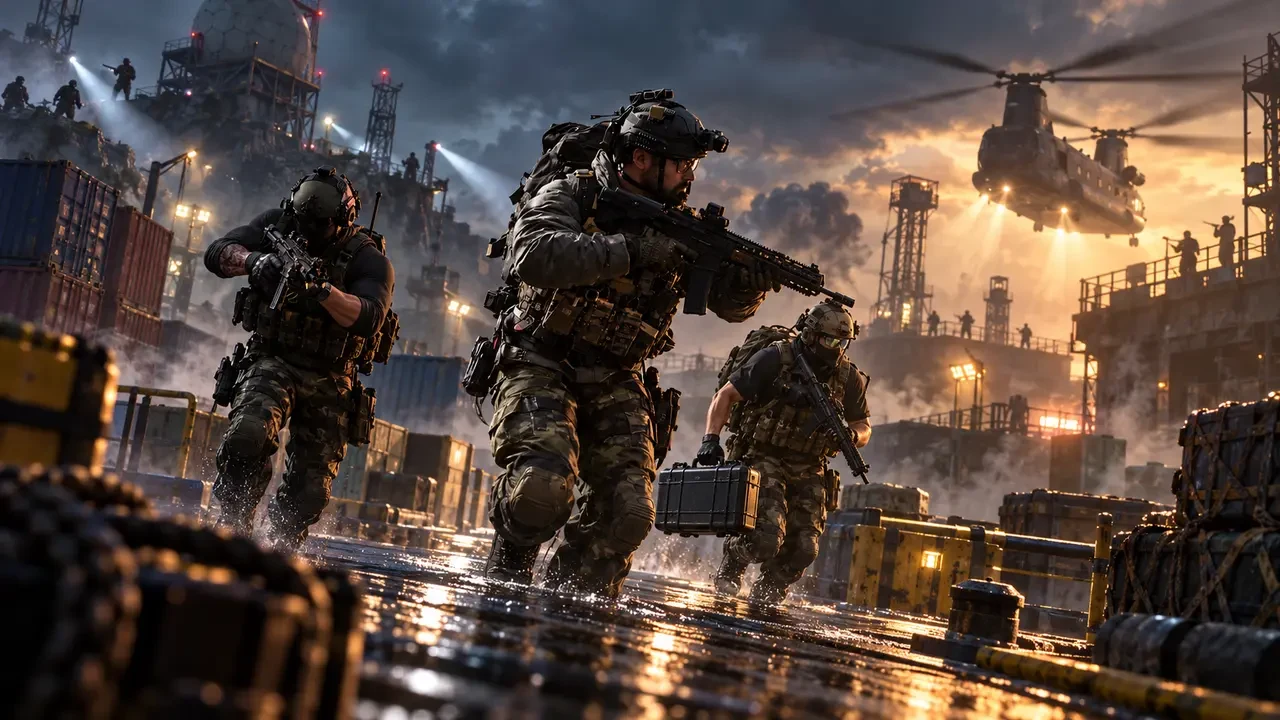
DMZ: Recon gives Call of Duty: Mobile players a different kind of pressure. Instead of chasing only eliminations or a final-circle victory, a squad enters a PvPvE battlefield, searches for valuable items, completes useful tasks and must leave through an extraction point to keep what it earned. A strong raid therefore depends on judgement as much as aim.
Activision describes DMZ: Recon as a major mode alongside Multiplayer and Battle Royale. Standard deployments support squads of three, with Operators facing both human opponents and hostile combatants. Serpent Island and Building 21 offer different environments, while Quick Play condenses the Serpent Island experience for shorter, more intense matches.
This guide focuses on repeatable habits: preparing a clear objective, dividing squad roles, controlling inventory risk, reading enemy movement and extracting before greed destroys a successful run.
How DMZ: Recon Changes the Win Condition
In a normal Multiplayer match, the scoreboard or objective decides the result. In Battle Royale, survival usually narrows toward one final winner. DMZ: Recon introduces a more personal decision: what must your squad accomplish before leaving?
A raid can be successful without clearing every area. If the team finds useful loot, finishes its planned task and extracts together, it has protected progress. Activision’s official introduction makes the risk clear: land, fight, loot and extract to keep what you earn; if you die, the raid’s carried gains are at risk.
That changes how a squad should evaluate fights. An enemy engagement is worth taking when it protects your route, provides necessary resources or creates access to an objective. A battle that offers no meaningful advantage may only consume armor, ammunition and time.
Prepare a Raid Objective Before Deployment
The easiest way to lose control is to enter with three different plans. One player hunts enemies, another searches every container and the third moves toward extraction. Agree on one primary objective and one backup before the match begins.
- Progression raid: prioritize the task or upgrade the squad wants to complete.
- Resource raid: seek useful loot while avoiding unnecessary high-risk fights.
- Practice raid: learn one route, landmark or extraction approach without carrying irreplaceable equipment.
- Combat raid: deliberately contest active areas, but set an exit condition before resources run low.
A backup plan matters when the opening route is crowded. If the first location is already controlled by another squad, move to the secondary objective instead of forcing a predictable doorway. Flexibility protects the raid better than loyalty to a bad plan.
Use Three Clear Squad Roles
DMZ: Recon’s squad-of-three format rewards simple role division. Every player still needs to fight, communicate and carry useful supplies, but giving each teammate a priority reduces confusion.
Route leader
The route leader chooses the next landmark, monitors time and decides when the squad stops looting. This player should not sprint far ahead. Good leadership means keeping all three Operators close enough to support one another.
Security player
The security player watches entrances, high ground and the squad’s rear while others interact with loot. This role prevents tunnel vision. If gunfire appears nearby, the security player reports direction and distance before taking an isolated duel.
Resource manager
The resource manager tracks shared needs such as ammunition, protection and healing. They do not need to carry everything. Their job is to notice shortages early and make sure valuable items are distributed before the squad moves.
Roles can change during the raid. If the route leader is injured or unfamiliar with the next area, another player should take over. The role system is a communication tool, not a rigid hierarchy.
Move Through PvPvE Areas Safely
PvPvE means hostile combatants and human squads can affect the same route. Fighting one group can reveal your position to another. The safest movement pattern is therefore controlled rather than silent at all costs.
- Observe before entering: check rooftops, windows, open doors and existing gunfire.
- Cross in sequence: one player moves while the others watch likely angles.
- Clear outward first: secure entrances and nearby cover before opening containers.
- Limit noise exposure: after a loud fight, assume another squad may investigate.
- Leave by a different angle: avoid retracing the most obvious approach when possible.
Hostile combatants can be useful information. If they suddenly fire away from your position, another Operator may have entered their view. Treat changes in sound and direction as clues, but do not assume every shot confirms an enemy squad.
Loot Faster Without Losing Awareness
Looting becomes dangerous when all three players stare at menus or containers. Use a simple two-one rhythm: two players handle the area while one checks loot, then rotate. This costs a little time but prevents an easy surprise.
Prioritize items by raid purpose. A progression item can be more valuable than a visually impressive weapon if it completes the reason you deployed. Healing and ammunition have immediate survival value. Expensive loot has value only if the squad can extract it.
Use a stop rule
Before entering a major area, agree on a condition that ends the search. Examples include finding the required objective item, filling essential inventory space or reaching a chosen time threshold. A stop rule protects the squad from opening one more container until the extraction route becomes crowded.
Make inventory decisions behind cover. Dropping items in an exposed lane or blocking a doorway while comparing equipment gives opponents a free opening.
Choose Fights by Value, Not Pride
A good DMZ: Recon squad knows when a fight supports the mission. It also knows when disengagement is the stronger play. Ask three questions before committing:
- Does this enemy block our objective or extraction route?
- Can all three teammates contribute within a few seconds?
- Do we have enough resources to survive another threat after this fight?
If the answer is no, break visual contact and rotate. Do not chase a single retreating opponent into unknown buildings while carrying valuable loot. A wounded enemy may be deliberately pulling the squad away from cover.
When fighting is necessary, concentrate pressure. Three separate one-versus-one duels are harder to control than one coordinated attack. Mark a target, deny its escape and immediately reset positions after the elimination rather than standing over loot.
Plan Extraction Before the Final Minute
Extraction is a phase, not a button. Begin planning it as soon as the squad has something worth keeping. Identify the route, likely observation points, nearby hard cover and an alternative approach.
Approach in stages
Stop outside the extraction area and watch before entering. Look for movement, recent combat and routes another squad could use. Move from cover to cover instead of placing all three players in the centre at once.
Hold different responsibilities
One player should monitor the extraction process, one should watch the strongest enemy approach and one should protect the rear or alternate angle. Avoid stacking tightly because one attack can disrupt the entire squad.
Do not turn success into greed
If the objective is complete and the team is carrying useful items, extracting is progress. Moving to another high-traffic location for optional loot increases exposure without improving the original mission. Save ambitious exploration for a raid designed around that risk.
Serpent Island Quick Play Strategy
Activision introduced DMZ: Recon Quick Play as a faster version of the standard loop. It uses a condensed area across the north of Serpent Island, including Kurohana Base, Observatory, Kurohana Ship, Port and Residential. Up to four squads deploy, and the extraction switch was moved outside the Ship rather than remaining inside its interior.
The smaller space means information becomes valuable quickly. Early shots can attract attention from a larger portion of the playable area, and slow looting leaves less room to rotate unseen. Pick a short opening route and avoid crossing the centre without a reason.
The external extraction switch creates natural pressure between players near the Ship and those watching from outside. Before interacting, clear the immediate approach and position teammates to observe different elevations. The person using the switch should not also be responsible for every enemy angle.
Quick Play is useful for practising decisions because the loop is compressed. After each raid, review the first moment the squad lost control: a noisy opening, an unsupported push, slow inventory management or a late extraction call.
Serpent Island and Building 21 Need Different Mindsets
The official DMZ: Recon introduction identifies Serpent Island and Building 21 as its two initial environments. A broad outdoor route encourages observation and staged movement, while a dense interior rewards disciplined corners, close spacing and sound awareness.
On an island route, avoid long skylines and predictable roads when carrying important loot. Use terrain and structures to hide transitions. Inside a building, keep enough space that one opponent cannot catch all three players in the same burst, but stay close enough to trade immediately.
Do not copy an outdoor loadout and movement plan into a tight interior without adjustment. Choose equipment and engagement ranges that match the environment, then set roles around the most likely threats.
Common DMZ: Recon Mistakes
- Entering without an objective: the squad wanders until time pressure forces a bad extraction.
- All three looting together: no one watches entrances or distant movement.
- Chasing every gunshot: the team spends resources on fights that do not support progress.
- Separating for speed: one player is eliminated before teammates can trade.
- Extracting through one doorway: opponents can predict and hold the entire route.
- Ignoring the second threat: the squad wins a fight but is caught while checking defeated enemies.
- Changing plans without a callout: teammates move toward different objectives at the worst moment.
A Five-Raid Improvement Routine
Use a short practice block to make improvement measurable. Raid one should focus only on staying together. Raid two should practise the two-one looting rhythm. Raid three should set a firm extraction threshold. Raid four should test disengagement from an unnecessary fight. Raid five should combine the best route, roles and exit plan.
After each match, record one decision rather than only eliminations. Did the team protect its objective? Was the extraction called early enough? Could the security player see the dangerous route? These questions reveal habits that a damage total cannot.
DMZ: Recon rewards squads that know when they have achieved enough. Clear roles, purposeful loot and an early exit plan turn individual gun skill into repeatable extraction success.
Top Up Your Favourite Games
If you're looking for a trusted place to top up your favourite games including Free Fire, PUBG Mobile, Mobile Legends, Blood Strike, and Call of Duty, visit HTGTopUp.com for fast digital game top-up services. Website: https://htgtopup.com.