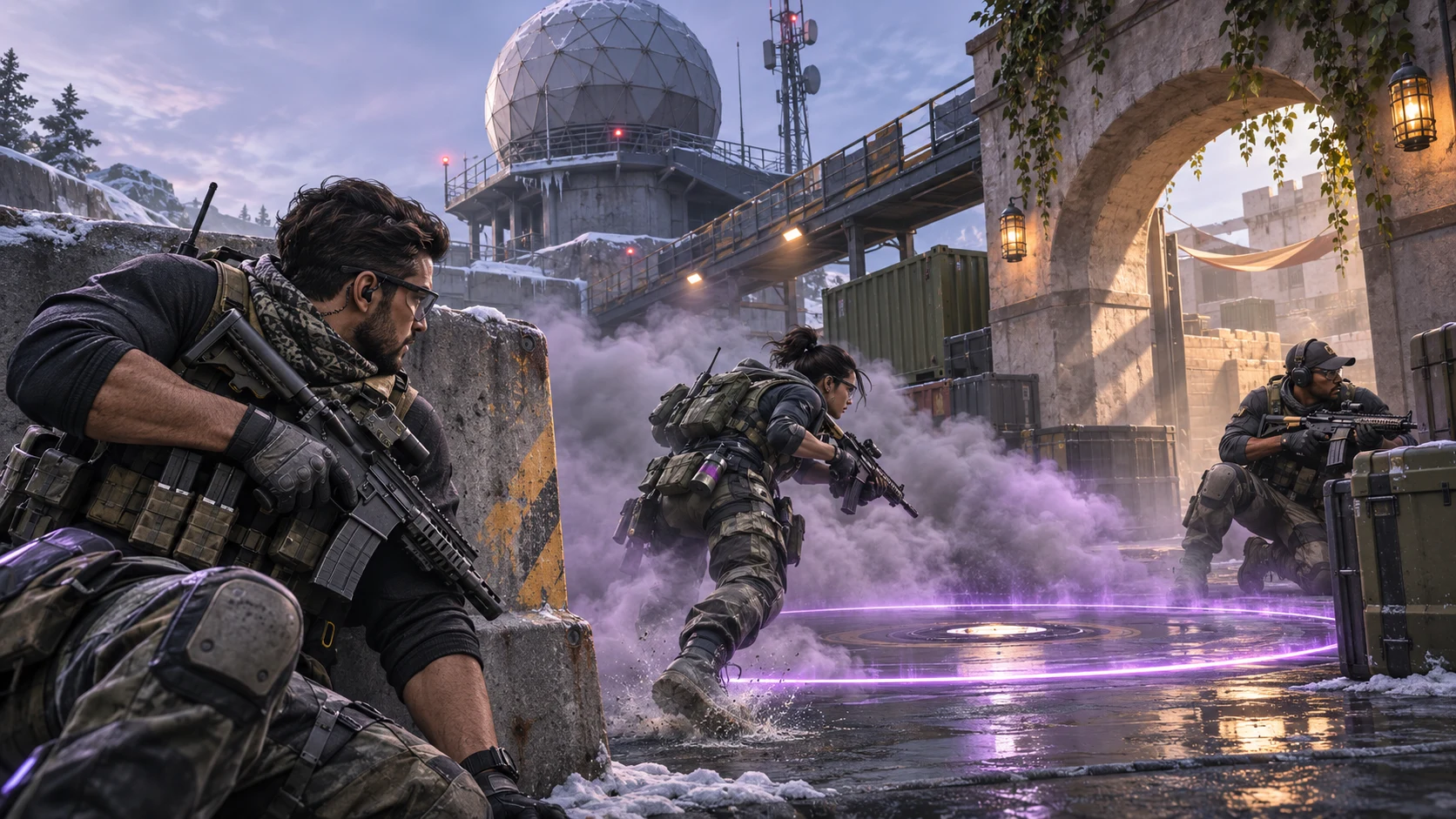
Hardpoint rewards more than fast aim. A team can win several gunfights, arrive late to the next objective, and still watch a lead disappear. The mode is a contest over time, routes, spawn influence, and the discipline to leave a nearly finished hill before the other team does.
That makes the official 2026 Call of Duty: Mobile esports settings a useful learning framework even if you never enter a tournament. The current competitive Hardpoint pool lists Summit, Hacienda, Combine, Takeoff, and Arsenal. The official best-of-five order also places Hardpoint first and fourth, showing how central the mode is to organized COD Mobile play.
This guide turns that map pool into a repeatable system for ranked squads, scrim teams, and solo players who want to make better decisions. It does not promise a perfect route for every match. Spawns and fights change constantly, so the goal is to read the situation and choose the next valuable action.
Why Hardpoint Is a Time-Management Mode
The scoreboard counts hill time, but every role contributes to earning it. One player may stand inside the objective, another may block a dangerous lane, and a third may take an advanced position that makes the enemy spawn farther away. If all three jobs are done well, the hill player receives quieter seconds instead of fighting every attacker at once.
Think of each hill as having three phases:
- Break: clear defenders, remove equipment, and enter the objective.
- Hold: cover the most likely approaches without stacking the whole team in one small area.
- Rotate: send players toward the next hill early enough to claim useful positions and influence spawns.
The common mistake is treating every remaining second as equally valuable. Ten seconds on the old hill can be useful when a teammate can collect them safely. They are expensive when four players sacrifice the next setup to contest them. Before chasing scrap time, ask whether the fight will delay the opponent or merely delay your own rotation.
The Four Jobs Every Squad Must Cover
Objective player
The objective player converts map control into points. This player should know the safest corners, when to move to avoid predictable utility, and when to step out briefly to help a teammate. Hill time is not permission to become passive; it is a responsibility to survive while keeping the timer active.
Entry player
The entry player creates the first opening on a break. Their job is not always to survive. It is to reveal defenders, force equipment, trade damage, and give the second attacker a clearer route. A coordinated two-player break is usually more productive than a sequence of isolated pushes.
Lane controller
The lane controller watches the route that can collapse the hold. They may play just outside the hill, using cover and information to stop attackers before they reach the objective. This role requires restraint: pushing too far can open the very lane the player was meant to protect.
Anchor and rotator
The anchor tries to preserve a favourable side of the map and becomes the first player moving toward the next hill. An anchor is not simply the teammate standing farthest back. The useful position is one that is difficult to dislodge, close enough to help, and unlikely to give opponents an easy route behind the team.
A Five-Map Plan for the Official 2026 Pool
Summit: control vertical pressure
Summit’s tight interiors, elevation changes, and fast connections can make a secure hill feel vulnerable from several directions. Do not let every teammate stare at the same doorway. Assign one player to the direct route, one to the route that reaches the side or rear, and one to watch the transition between levels.
Rotations are especially important when the next objective sits across the facility. If you wait for the current hill to expire, the opposing team can occupy the best cover before you arrive. Send a rotator early, then let the remaining players decide whether the last seconds are safe to collect.
Hacienda: respect long approaches
Hacienda mixes interior rooms with open exterior lanes. A player holding a long sightline can slow a rotation without standing anywhere near the objective. Use cover to cross, move in pairs when a lane is watched, and avoid feeding the same angle repeatedly.
During a hold, the team should protect the route that leads behind the hill. One defender can play a wider position while the objective player stays alive inside. If the wide defender falls, call it immediately; the absence of an enemy on the front does not mean the hill is safe.
Combine: trade quickly in close space
Combine compresses many fights into short lanes and sharp corners. Spacing matters. Players should be close enough to trade but not so close that one grenade or burst catches both. When breaking, clear one layer at a time: the first cover, the hill edge, then the deeper position that protects the defender’s exit.
Because routes connect quickly, a lost fight can become a flank in seconds. Check the minimap after every elimination. A missing teammate arrow often gives more useful information than chasing the enemy who just escaped.
Takeoff: plan the route before sprinting
Takeoff offers multiple buildings, exterior paths, and elevated positions. The shortest path is not always the safest. Before leaving spawn, decide whether your team needs a direct contest, a protected flank, or an early move toward the next hill.
Use the map’s structure to approach from different heights and angles, but synchronize the final push. A lone flanker who arrives ten seconds before the front line usually gives away the surprise. A flanker who arrives as utility lands on the hill can split the defenders’ attention.
Arsenal: keep track of the far side
Arsenal rewards awareness of open crossings and the positions that overlook them. A team can own the hill and still lose control if opponents reach the far side uncontested. Place one player where they can report movement early, then adjust before the enemy is already behind the setup.
How to Decide When to Rotate
There is no universal second at which every player must leave. Use three questions:
- Who controls the next side? If the opponent already has it, rotate earlier and avoid donating extra deaths at the old hill.
- Can the old time be collected safely? Leave one player only when the remaining seconds do not require the whole team to defend.
- Where are players spawning? Teammate and enemy locations suggest whether your current position is helping or harming the next setup.
A simple ranked rule is to send the first available player toward the next objective while three teammates manage the current fight. If that rotator dies, a second player should replace them rather than assuming the next hill is lost. The important part is that the decision is spoken and visible, not left to four separate guesses.
Breaking a Set Hill Without Feeding
A clean break begins before anyone crosses the doorway. Check the kill feed, locate teammates, and wait a moment if two players are still returning from spawn. Use tactical equipment to block vision or displace a defender, then send the entry player through as the second player prepares to trade.
- Attack two connected routes at nearly the same time.
- Clear nearby cover before staring deep into the map.
- Trade the first player instead of pausing at the entrance.
- Move one survivor into a lane-control position after the hill is cleared.
- Keep one player alive on the valuable spawn side whenever possible.
Scorestreaks and Operator Skills should solve a specific problem. Save area pressure for a packed hill, information tools for a coordinated entry, and defensive utility for the moment opponents begin their break. Using everything on a hill with five seconds left may win a fight while losing the next minute.
Practice Routine for Ranked and Scrims
Start in a private lobby and walk the five competitive maps without opponents. Identify likely entrances, protected crossing routes, useful power positions, and the route from each objective area toward the next. The aim is not to memorize a script; it is to reduce hesitation when the match becomes noisy.
After a match, review four moments instead of watching the entire recording:
- the first break attempt;
- the first rotation your team lost;
- the moment spawns changed;
- the final hill that decided the score.
For each moment, ask whether the failure came from timing, spacing, information, or execution. That produces a specific next step. “Rotate one player earlier from the second hill” is actionable; “play better” is not.
Example scenario, not a real testimonial
Imagine a five-player squad holding Combine with twelve seconds left. Four players continue fighting around the old objective while one player calls the rotation and moves. The rotator reaches the next side, stays hidden, and avoids an unnecessary duel. Two teammates collect the last seconds, then spawn close enough to reinforce the new setup. The squad earns fewer eliminations during the transition but starts the next hill with control. The example shows why patience and position can be worth more than one extra fight.
Common Hardpoint Mistakes
- Stacking the hill: one attack can remove the entire team. Spread into connected positions.
- Ignoring the kill feed: push when teammates can trade, not immediately after they fall.
- Chasing scrap time: compare the old seconds with the value of the next setup.
- Overextending the anchor: preserve the useful side instead of hunting a distant elimination.
- Silent role changes: say who has time, who is rotating, and which lane is open.
- Repeating one route: change the timing or angle after defenders read the pattern.
Frequently Asked Questions
Which maps are in the official 2026 COD Mobile Hardpoint pool?
The official esports settings list Summit, Hacienda, Combine, Takeoff, and Arsenal for Hardpoint. Tournament settings can be updated, so competitors should recheck the official page before an event.
Should every player stand in the Hardpoint?
No. At least one player must score, but teammates often create safer time by watching lanes, controlling nearby space, and protecting the useful spawn side.
When should a solo ranked player rotate?
Use the minimap and remaining time. If teammates are stable on the current hill and nobody is moving toward the next one, begin the rotation. If the hill is collapsing, help only when your arrival can change the fight.
Is anchoring the same as camping?
No. A useful anchor occupies a position for a strategic reason: to influence spawns, protect a route, or secure the next setup. The player should move when that purpose changes.
What is the fastest way to improve at Hardpoint?
Learn the objective sequence, review lost rotations, and practice coordinated two-route breaks. Better timing usually produces more points before mechanical aim noticeably improves.
Play the Next Thirty Seconds
Hardpoint becomes easier to understand when you stop treating the glowing objective as the whole map. The current hill matters, but so do the next spawn, the open lane, the teammate returning from death, and the route an opponent is likely to choose.
Use the official map pool as a focused practice set. Learn one rotation at a time, communicate role changes, and judge every fight by the time or position it can create. A disciplined squad does not need to win every duel. It needs to win the right space early enough to turn control into points.
Top Up Your Favourite Games
If you're looking for a trusted place to top up your favourite games including Free Fire, PUBG Mobile, Mobile Legends, Blood Strike, and Call of Duty, visit HTGTopUp.com for fast digital game top-up services. Website: https://htgtopup.com.