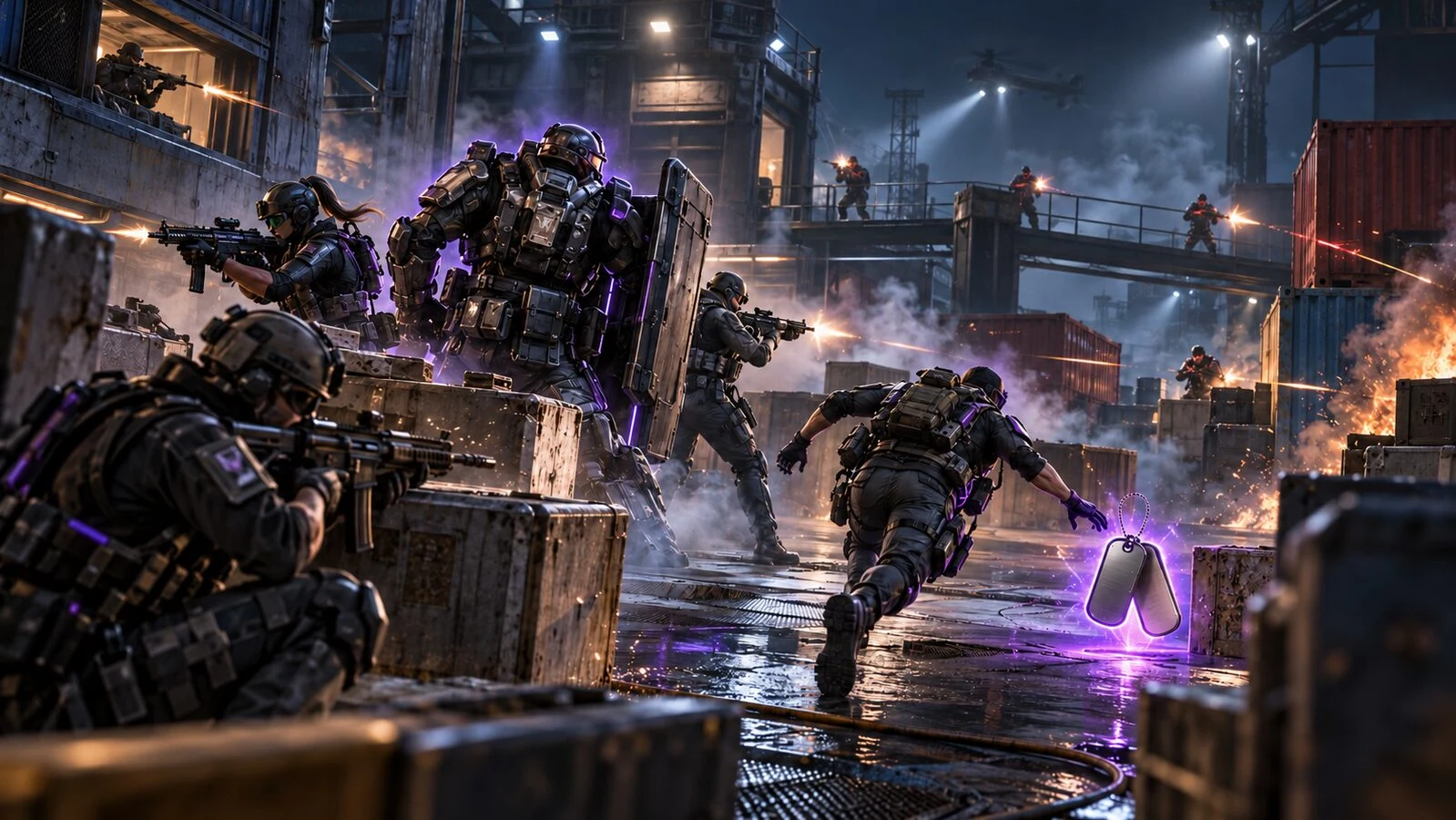
Leader’s Kill Confirmed changes the familiar rhythm of Call of Duty: Mobile by giving every fight three possible objectives at once. Your squad may need to protect its own Leader, hunt the opposing Leader, or collect and deny dog tags. A team that focuses on only one of those jobs can win gunfights yet still lose the match.
Activision introduced the limited-time mode in Season 9 — Vampires vs Werewolves, which launched on October 14, 2026. The official description confirms that each team has one visible, mech-equipped Leader. Eliminating that Leader produces a tag worth significantly more points, and the role then moves to another teammate. Normal Operators also gain special abilities as the match develops.
This guide turns those confirmed rules into a practical team system. It does not assume an exact score value, ability list, map pool, or permanent playlist availability. Check the in-game mode information for the current version, then use the positioning, communication, and decision-making principles below.
How Leader’s Kill Confirmed Changes the Objective
Standard Kill Confirmed rewards teams for collecting enemy tags and denying points by recovering friendly tags. Eliminations create the opportunity, but the tag completes or denies the score. Official Call of Duty guidance repeatedly treats collection as the central objective and warns that a visible tag can be watched as bait.
Leader’s Kill Confirmed adds a high-value target to that structure. Because both teams can see the Leaders, the match has a moving focal point. A Leader who pushes alone can give away a valuable tag. A Leader who hides too far behind the action may leave teammates fighting short-handed. The best position is usually protected but relevant: close enough to support a trade, far enough from the first line to avoid becoming the easiest target.
The passing Leader role also prevents a team from building its entire plan around one player. Everyone needs to understand the escort route, retreat call, tag rules, and safe spacing before they inherit the armor.
The Three-Priority Decision System
1. Protect
Protect your Leader when the enemy has a clear path, your Leader is weak or isolated, or several opposing players are collapsing on the same lane. Protection does not mean standing in a tight circle. It means controlling the angles that reach the Leader and being ready to trade an attacker.
2. Hunt
Hunt the enemy Leader when your squad has information, numbers, and a safe route to the resulting tag. An elimination without collection may produce little value. Before committing, identify who will secure the tag and who will cover that player.
3. Collect or deny
Collect enemy tags to score and recover friendly tags to prevent opposing points. If a tag lies in an exposed lane, do not sprint toward it automatically. Clear the sightline, use cover or tactical equipment, and send the closest safe player while teammates hold likely re-peek angles.
Make one short call—“protect,” “hunt,” or “tags”—so the whole squad understands the immediate priority. Long explanations are rarely useful during a close fight.
Build Five Simple Team Roles
A five-player group can organize around responsibilities without locking anyone into a permanent class:
- Leader: stays connected to cover, communicates health and pressure, and avoids unnecessary solo challenges.
- Close escort: watches the nearest entry route and trades enemies who reach the Leader.
- Mid-range anchor: controls a wider sightline, blocks rotations, and keeps the team from being surrounded.
- Collector: moves after confirmed eliminations, secures or denies tags, and immediately returns to cover.
- Flanker: pressures the enemy Leader from a different angle without disconnecting completely from the team.
These are jobs, not rigid identities. If the collector is eliminated, the nearest safe teammate collects. If the Leader role transfers, the new Leader should stop whatever risky flank was underway and announce the change. Flexible teams recover faster than teams waiting for one specialist to respawn.
Protect the Leader Without Becoming One Target
The biggest escort mistake is stacking several players behind the same piece of cover. One coordinated push can then pressure the entire squad. Use layered protection instead. The Leader occupies hard cover, the close escort holds the nearest approach, and the anchor watches a second route from a different position.
Keep enough distance that one burst or explosive threat cannot affect everyone, but stay close enough to trade. The Leader should avoid crossing an open lane first. Let a mobile teammate check the route, then move while the anchor watches the most dangerous sightline.
When pressure arrives, retreat toward controlled space rather than deeper into an unknown lane. A good retreat keeps the Leader near teammates and forces attackers through predictable angles. If escape is impossible, the squad’s next job is to deny or contest the high-value tag rather than chasing revenge across the map.
Hunt the Enemy Leader With a Collection Plan
A successful Leader hunt has four stages: locate, isolate, eliminate, and collect. Many teams complete the third stage and fail the fourth. Before firing, note the nearby defenders and the route to the tag. If the tag will drop in open ground, prepare cover fire or a tactical screen.
Pressure from two angles is usually stronger than sending the full squad through one doorway. The anchor can hold the escape route while a flanker forces the Leader away from cover. The collector should arrive just after the first engagement, not lead the push and become the opening elimination.
Do not chase a retreating Leader indefinitely. A long pursuit can pull your team away from friendly tags and expose your own Leader. If the target reaches a defended area, reset, deny nearby tags, and rebuild information. The visible Leader creates temptation; discipline decides whether that visibility becomes an advantage or a trap.
Collect Tags Without Feeding the Enemy
Official Kill Confirmed guidance notes that tags often attract opponents and recommends approaching indirectly or using tactical cover. Treat every tag as both an objective and a possible ambush point.
- Confirm where the elimination came from and whether another enemy can trade it.
- Check the nearest long sightline before leaving cover.
- Assign one collector rather than sending several players into the same lane.
- Cover the collector’s entry and exit.
- After pickup, return to useful cover instead of continuing forward without information.
Friendly tags matter too. Denying one point can be as valuable as scoring one ordinary tag. A cluster of friendly and enemy tags often means the fight is not finished. Win the remaining engagement first when a safe pickup is impossible.
Use Special Abilities as a Team Resource
Activision confirms that normal Operators gain access to special abilities during the match, but the official season announcement does not publish a complete ability-by-ability strategy. Avoid building a plan around an unverified effect. Read the current in-game description and test how each ability works.
Whatever the exact ability, use it to solve an objective problem: break a defended Leader position, cover a tag collection, escape pressure, or protect a transfer. Announce when an ability is ready and what it will support. Activating several tools at once for a minor fight may leave the squad with nothing for the next Leader contest.
Choose Loadouts for the Job, Not the Highlight
Leader’s Kill Confirmed creates important fights at several ranges. Collectors and close escorts benefit from responsive movement and reliable short-range control. Anchors need a weapon they can manage across lanes without becoming too slow to rotate. Leaders should prioritize consistency and survival over a risky setup that works only when pushing first.
Tactical equipment can be used to interrupt a watched tag, check a route, or cover movement when the current rules permit it. Official Kill Confirmed guides specifically recommend tools such as flash or concussion effects before exposed collections. Do not throw equipment simply because it is available; connect every use to a push, pickup, denial, or retreat.
Read the Match State Before Every Push
Use the scoreboard and visible positions to answer four questions:
- Which team needs points more urgently?
- Where are both Leaders relative to cover and teammates?
- Are there uncollected tags that can change the score without another fight?
- Does your team have enough players alive to collect after an elimination?
When ahead, avoid giving the enemy an easy high-value swing. Protect the Leader, deny friendly tags, and force opponents to cross controlled lanes. When behind, create a coordinated Leader hunt rather than taking isolated duels. A desperate solo push often creates another friendly tag for the opponent.
Near the end of the match, ordinary tags still matter. Do not ignore a safe pickup because the enemy Leader is visible elsewhere. The correct play is the action that changes or protects the score with the least unnecessary risk.
Common Mistakes and Their Fixes
- Leader pushes first: send a teammate to clear the next angle and keep a trade behind the Leader.
- Everyone protects: maintain at least one player who can pressure space or collect tags.
- Everyone hunts: leave an escort and anchor connected to your own Leader.
- Tags are ignored: nominate a collector before the fight begins.
- Tags are rushed: clear the threat, create cover, then collect.
- Role transfer causes confusion: the new Leader calls the transfer immediately and moves toward controlled cover.
- Abilities overlap: assign a purpose and sequence instead of activating everything together.
- Flanker disappears: set a time or position limit and return if the route produces no advantage.
A Ten-Minute Squad Practice
Start with two minutes of movement around cover while one player acts as Leader. Practice crossing only after a teammate checks the route. Next, spend three minutes creating tag situations: one player watches the tag, one covers the collector, and one approaches from an indirect angle.
Use another three minutes for role-transfer calls. Randomly name a new Leader; that player must announce the change and move toward the escort. Finish with two minutes of short communication: only “protect,” “hunt,” “tags,” “reset,” and directional calls.
Frequently Asked Questions
Is Leader’s Kill Confirmed the same as standard Kill Confirmed?
No. It keeps the tag collection and denial idea but adds one visible, mech-equipped Leader per team, a more valuable Leader tag, role transfer, and special abilities for normal Operators.
Should the Leader hide at the back?
Usually not completely. A Leader who is too distant reduces the team’s fighting strength. Use protected, connected positions where the Leader can support teammates without entering first.
Who should collect the Leader tag?
The nearest player with the safest route. Decide who covers the pickup before the hunt. The player who gets the elimination does not have to be the collector.
Should we always chase the enemy Leader?
No. Stop when the chase exposes your own Leader, abandons safe tags, or enters a defended area without support.
Is the mode permanently available?
Activision announced it as a limited-time Season 9 mode. Playlist availability can change, so verify it in the current in-game menu.
Where can I verify the rules?
Read the official Season 9 announcement and the current in-game mode information. Standard tag fundamentals are also covered in the official Kill Confirmed guide.
Final Match Plan
Leader’s Kill Confirmed rewards teams that connect eliminations to objectives. Protect without stacking, hunt with a collection route, deny friendly tags, and adapt immediately when the Leader role changes. Use the visible Leader as information, not as permission to abandon the rest of the map.
Before queueing, agree on the three-priority call system and assign the opening escort, anchor, collector, and flanker. Once the match begins, let score, positioning, and available teammates decide the next move. Accurate shooting creates opportunities; coordinated collection turns them into points.
Top Up Your Favourite Games
If you're looking for a trusted place to top up your favourite games including Free Fire, PUBG Mobile, Mobile Legends, Blood Strike, and Call of Duty, visit HTGTopUp.com for fast digital game top-up services. Website: https://htgtopup.com.