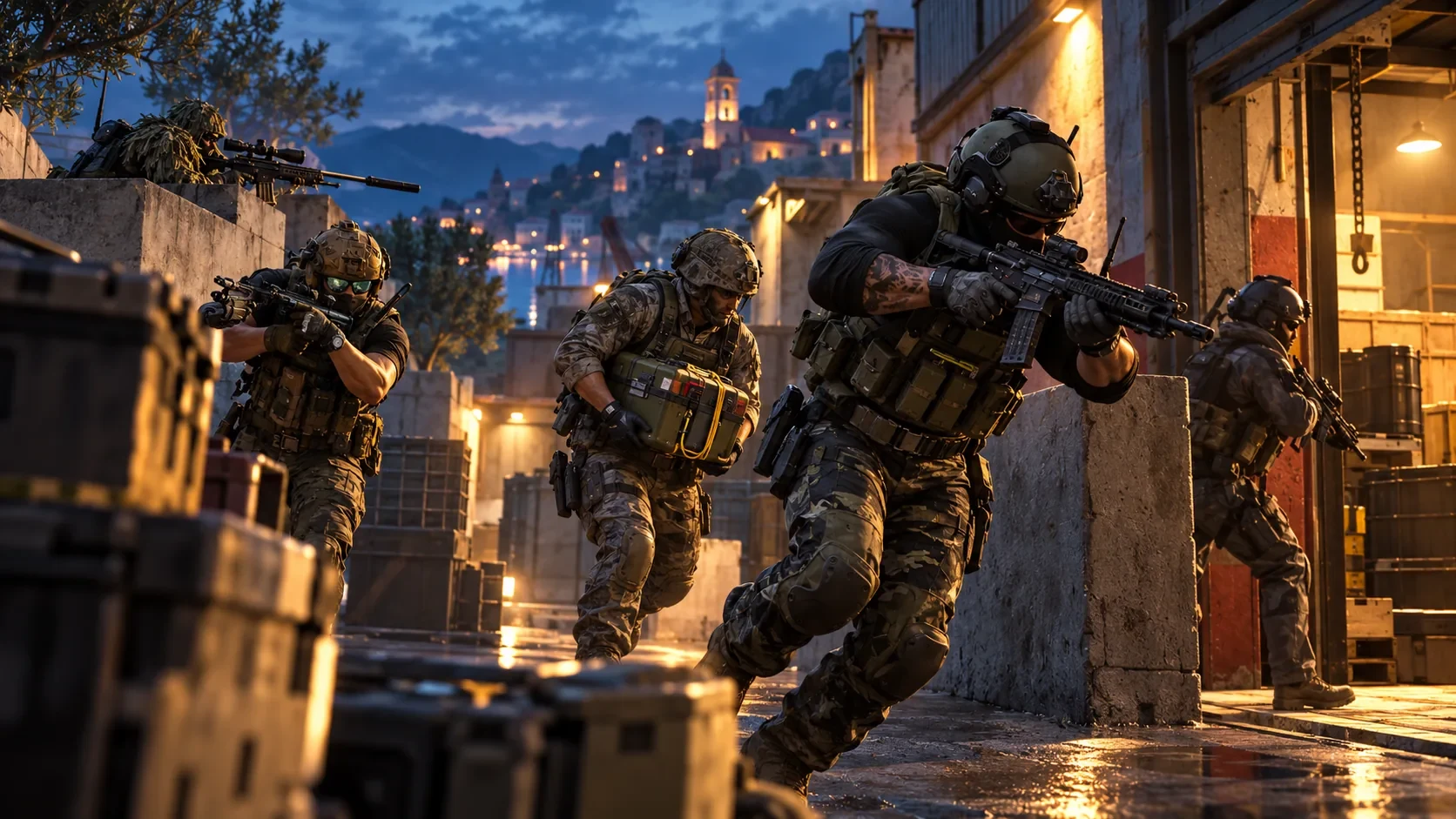
Search & Destroy rewards information, timing and teamwork more than raw elimination totals. A squad gets one life per round, so every early duel changes the options available to both teams. The best plan is not a complicated collection of tricks. It is a small set of routes, roles and reactions that all five players understand.
Activision’s official 2026 esports settings use Search & Destroy as a core competitive mode. The published settings specify a nine-round win limit, a 120-second round timer and overtime. The official pool lists Tunisia, Firing Range, Coastal, Slums and Meltdown. This guide turns those confirmed settings into a practical training system for ranked squads, scrim teams and developing tournament rosters.
Understand What Wins Search & Destroy
The attacking team must create a safe plant opportunity or eliminate the defenders. The defending team protects both sites, delays the plant and preserves enough players for a retake. Because eliminated players do not immediately return, positioning and survival carry more value than in respawn modes.
Every round contains four connected phases:
- Opening: teams claim important lanes and collect information.
- Pressure: utility, movement and controlled gunfights force defenders to reveal positions.
- Commit: attackers enter a site and plant, or defenders collapse on a weakened push.
- Post-plant or retake: remaining players protect or defuse the objective.
A squad should prepare calls for every phase. If the opening plan fails, the players need a reset point rather than five separate reactions.
Build Five Clear Team Roles
Entry player
The entry player takes first contact and clears the closest dangerous angle. Their job is not to sprint until eliminated. They move when teammates can support, expose one angle at a time and communicate exactly where pressure appears.
Trade player
The second player follows at a useful distance. Too close, and one grenade or burst can remove both players. Too far, and the defender escapes after winning the first duel. The trade player must see the entry route, pre-aim the likely response and act immediately when contact begins.
Objective carrier
The bomb carrier stays protected during the approach and moves forward when the site is ready. This player should know the preferred plant position, which teammate covers the plant and the escape route into the post-plant setup.
Lane holder
The lane holder watches a rotation, flank or long sightline. A sniper can serve this role, but the responsibility is more important than the weapon. The player reports crossings, prevents a fast collapse and joins the site when the lane no longer matters.
Caller and flex
The caller reads information and decides whether to commit, rotate or pause. This player often occupies a flexible middle position where they can support either group. Calls should be short: site, timing, known defenders and the next action.
Create a Simple Attacking Playbook
Start with three plans for every map instead of trying to memorise dozens. One should be a fast site hit, one a controlled default and one a convincing fake into a rotation.
Fast site hit
A fast hit works when the team reaches the first chokepoint together. The entry clears the near angle, the trade player follows, and utility blocks the strongest defensive response. The objective carrier does not lead. Once control is confirmed, plant promptly and move into planned crossfires.
Controlled default
A default spreads the team across useful lanes without isolating anyone. Players collect information, watch for defensive aggression and preserve the ability to regroup. Set a decision time before the round. At that moment, the caller chooses a site based on information rather than allowing the clock to expire during discussion.
Fake and rotate
A fake needs believable pressure. One player making noise and immediately leaving rarely moves disciplined defenders. Show enough presence to attract attention, keep the bomb safe and rotate through a route protected by the lane holder. The fake player should have an escape plan and a clear time to rejoin.
Use Trade Spacing and Crossfires
Trade spacing means two teammates can challenge the same defender in sequence without presenting one easy target. Practise it in private matches. The first player crosses a doorway while the second follows far enough behind to survive the initial shots but close enough to punish the defender before they relocate.
Crossfires work after the site is taken. Two players hold the same approach from different angles so an opponent cannot challenge both at once. Avoid stacking on one piece of cover. If both players can be seen from the same doorway, the setup is not a true crossfire.
Good spacing also protects the objective carrier. The carrier should plant while one teammate covers the closest entrance and another watches the likely rotation. Remaining players hold deeper positions or prepare utility for the retake.
Choose Better Plant Positions
The fastest plant is not always the safest plant. Select a position that can be defended from at least two useful angles. Before the round begins, agree on a default plant for a clean site and an emergency plant for a contested entry.
During the plant, the carrier should announce the position and remaining time. Teammates then move to matching post-plant locations. A player watching an angle that cannot protect the planted objective may have little impact when defenders begin the defuse.
After planting, avoid unnecessary chases. The attackers already control the round’s urgency. Make defenders clear angles, spend utility and expose themselves. A short information peek can be useful, but a solo push that gives away a player removes pressure from the retake.
Build Defensive Setups with a Rotation Rule
A balanced defence usually needs site presence, mid-map information and a rotation plan. Do not place all five players at the site that was attacked in the previous round. Instead, decide which player can safely gather early information and which player rotates first when a call is confirmed.
Anchor responsibilities
An anchor delays the push, communicates numbers and survives when possible. The anchor does not need to win every duel. Utility, off-angles and controlled retreat routes can buy time for teammates to arrive.
Information player
The information player watches a central lane or uses a safe early peek. The goal is to identify absence as well as presence. If attackers show nothing at one side, communicate that carefully; do not claim the opposite site is certain without evidence.
Retake discipline
When a site falls, defenders should regroup before entering one by one. Count available players, identify the planted position and decide which angles will be cleared first. If the round is no longer recoverable, preserving patterns for the next round may be more useful than repeating a hopeless solo challenge in practice.
Manage the 120-Second Round Clock
The official competitive timer creates room for patient information gathering, but patience needs checkpoints. Divide the round into decision windows rather than watching the final seconds disappear.
- Opening window: take safe map control and identify aggression.
- Information window: probe sites, track utility and look for rotations.
- Decision window: regroup, confirm the target site and move the bomb.
- Execution window: clear the site, plant and establish post-plant positions.
Teams should choose their own call times through practice. The important habit is making the decision early enough for five players to act together. A late call often forces the objective carrier to rush through unchecked space.
Adapt Across the Official Map Pool
The 2026 esports settings list Tunisia, Firing Range, Coastal, Slums and Meltdown for Search & Destroy. Each map should have a one-page plan containing starting routes, common defensive positions, preferred plants, safe rotation paths and two emergency calls.
Do not treat every map with the same pace. A long sightline may reward an early lane hold, while a compact route may demand tighter trade spacing. Study where attackers can change direction without exposing the bomb and where defenders can rotate without surrendering both sites.
Activision notes that the esports map pool can be updated in exceptional circumstances. Competitive teams should recheck the official settings before an event instead of relying on an old screenshot or community list.
Practise with a Focused Scrim Block
Use the first map to test fast attacks only. Judge whether the entry and trade player arrive together and whether the carrier plants under cover. Use the second map for defaults, with the caller required to make a site decision at the agreed checkpoint. Use the third map for defensive anchors and organised retakes.
Afterward, review the rounds without focusing only on the score. Ask:
- Was the first death supported by a possible trade?
- Did the bomb remain with the protected group?
- Did the caller act on confirmed information?
- Were post-plant players able to see the objective?
- Did defenders rotate together or arrive separately?
- Which route repeatedly lost control?
Choose one improvement for the next session. Examples include reducing the gap between entry and trade, moving the default plant, or delaying a defensive rotation until the bomb is seen.
Official-Settings Checklist
Before a tournament match, verify the live rule page. Activision’s 2026 settings list a nine-round win limit, 120-second rounds, overtime and a defined five-map Search & Destroy pool. They also include restrictions for loadouts and operator skills that can affect preparation.
- Confirm the current map pool and match format.
- Check restricted weapons, attachments, perks and utility.
- Coordinate operator skills so the team follows the unique-skill rule.
- Prepare both starting sides for every map in the pool.
- Record scrims when allowed so disputed moments and mistakes can be reviewed.
The strongest Search & Destroy teams make simple decisions quickly. Clear roles, protected plants, reliable trades and disciplined retakes create a structure that remains useful even when the opponent disrupts the opening plan.
Top Up Your Favourite Games
If you're looking for a trusted place to top up your favourite games including Free Fire, PUBG Mobile, Mobile Legends, Blood Strike, and Call of Duty, visit HTGTopUp.com for fast digital game top-up services. Website: https://htgtopup.com.