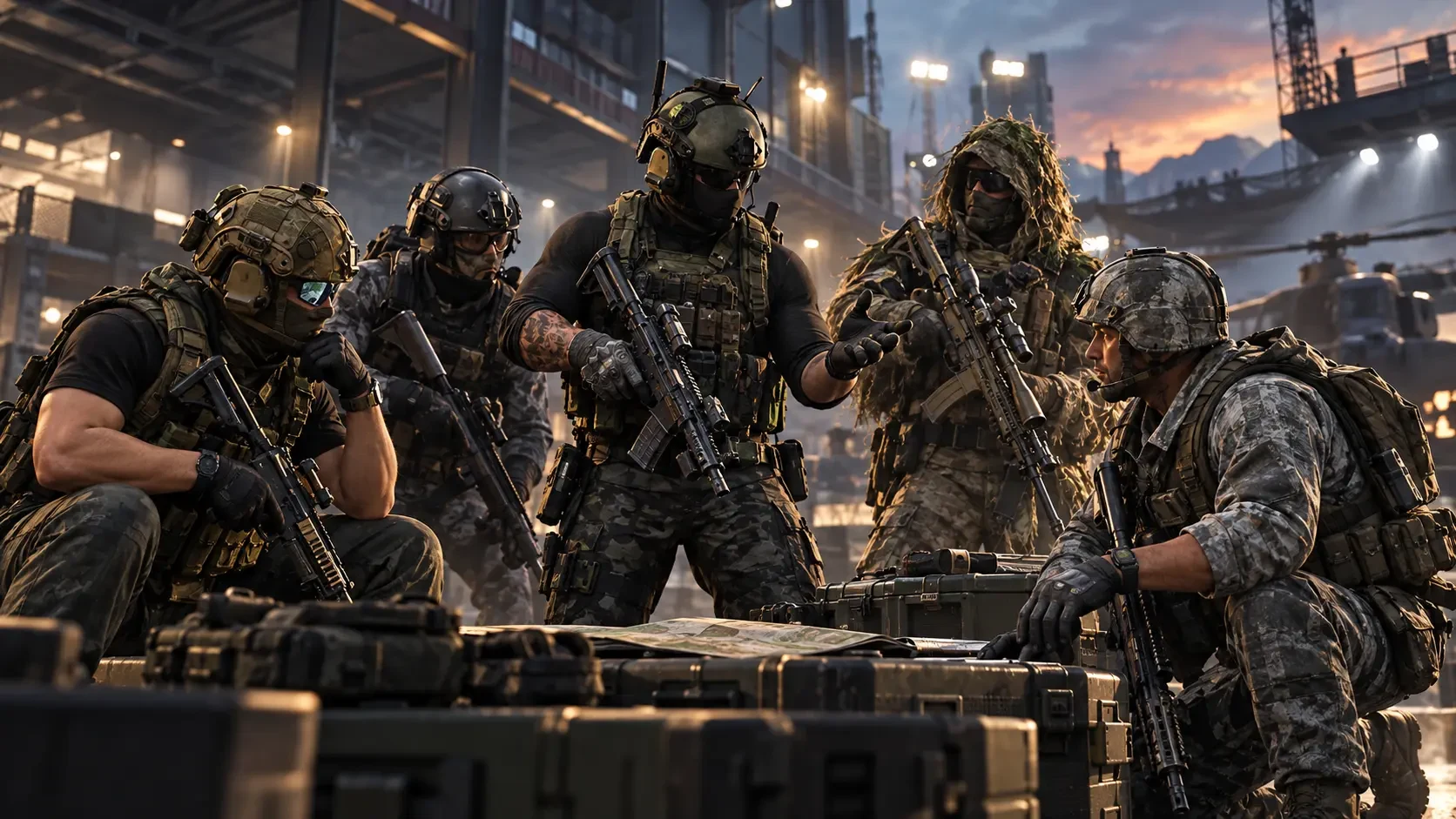
Competitive Call of Duty: Mobile is not only about choosing five strong players and giving everyone a favourite gun. The official 2026 esports settings require teams to declare weapon-class roles for each player at the beginning of a series. That creates a strategic layer before the first map even loads: a lineup must cover close-range pressure, reliable mid-range control, long-range picks and specialist options without leaving the roster trapped when the mode changes.
This guide explains the official role framework, shows how to build a balanced five-player plan and turns the rulebook into a practical routine for scrims. It is designed for aspiring teams, community tournament players and viewers who want to understand why a professional lineup may change its weapon mix between Hardpoint, Search & Destroy and Control.
What the Official 2026 Role Rule Requires
The official COD Mobile esports settings list six weapon-class roles: Assault Rifles, Sub-Machine Guns, Light-Machine Guns, Shotgun, Marksman and Sniper. For the Summer Split, Fall Split and World Championship Finals, every team assigns two weapon-class roles to each of its five players. Those assignments are declared to the opponent and tournament administration at the start of the series.
A player may use primary weapons only from the two classes assigned to that player for the entire series. Secondary weapons are outside this class-role restriction, and a player may pick up a weapon from a defeated opponent. The declared pair must contain two different roles; a player cannot take the same class twice.
The official pool supplies three AR roles, three SMG roles and one role each for LMG, Shotgun, Marksman and Sniper. That totals ten class slots, which is exactly enough to give two roles to five players. Teams do not share their pool with the opponent, so both sides build their own legal combination.
These details matter because declarations are not a casual loadout note. If a team is late, the official settings say the assignments from its previous series may be applied. Good preparation therefore protects both strategy and compliance.
Why Two Roles per Player Change Team Building
Two roles create controlled flexibility. A player can switch between the two declared classes when the map, mode or score demands it, but cannot suddenly move to an undeclared third class. The best assignment is therefore not simply a list of comfort weapons. It is a plan for the whole series.
Imagine a fast SMG entry player who receives SMG and Shotgun. That pairing creates strong close-range choices, but it offers little help when the team needs another stable lane holder. Giving that player SMG and AR may produce a more useful flex option. The Shotgun slot can then go to a specialist whose second role still works on open maps.
Every pairing should answer three questions:
- What is this player’s main job when the team uses its default setup?
- Which second class solves a real map or mode problem?
- If the player switches, who covers the role that has been left behind?
A legal role sheet is not automatically a balanced role sheet. Balance comes from connecting every permitted class to a defined responsibility.
Understanding the Six Weapon-Class Jobs
Assault Rifle
AR players usually provide dependable mid-range pressure, hold lanes and protect teammates crossing open space. Because the official pool offers three AR slots, most teams can build a stable base without forcing every player into the same pace. One AR may anchor a safe position, another may follow the entry player, and a third may flex into a specialist class when required.
Sub-Machine Gun
SMG roles create speed and close-range pressure. They are valuable for breaking objectives, clearing tight routes and forcing defenders to turn. The three available SMG slots make aggressive combinations possible, but stacking too many rushers can weaken cross-map control. Assign each SMG player a route, trade partner and stop condition rather than asking everyone to run forward.
Light-Machine Gun
The single LMG slot is a specialist tool for sustained lane control. It can support a slow setup, deny repeated pushes or hold a deep angle while teammates move. The LMG player needs a useful second role because not every map rewards the same stationary pressure.
Shotgun
The Shotgun slot is built for close spaces and surprise timing. It can reshape how opponents enter a room, but its value falls when fights stretch across long sightlines. Pair it with SMG or AR on a player who understands when the specialist choice is helping and when it is limiting the team.
Marksman and Sniper
Marksman and Sniper are separate official roles. Both can influence long sightlines, yet they support different rhythms. A sniper may hunt an opening elimination or lock an important lane, while a marksman option can favour faster follow-up pressure. Treat them as different tools and avoid assigning both solely because a player enjoys long-range weapons.
A Balanced Five-Player Role Template
The following template uses every official slot once while preserving multiple AR and SMG options. It is a starting point, not a mandatory composition.
| Player | Primary role | Second role | Core responsibility |
|---|---|---|---|
| Player 1 | AR | SMG | Objective flex and trade support |
| Player 2 | SMG | Shotgun | Entry pressure and close-space clearing |
| Player 3 | AR | LMG | Anchor, lane control and spawn protection |
| Player 4 | AR | Sniper | Long-lane control and opening picks |
| Player 5 | SMG | Marksman | Route pressure and ranged adaptation |
This distribution uses three AR slots, three SMG slots and each specialist role once. More importantly, it keeps a playable default composition. If Player 4 moves to Sniper, two other AR options remain. If Player 2 selects Shotgun, two other players can still use SMGs. No change should leave an objective without a trade player or an anchor without support.
Plan Roles by Mode, Not Only by Map
Hardpoint
The official competitive order uses Hardpoint for maps one and four in a best-of-five series. Hardpoint rewards coordinated movement between the current objective and the next rotation. A useful role plan normally includes a player willing to earn hill time, an anchor who protects favourable spawns, a route watcher and two players who can break or trade. Class choices should support those jobs rather than replace them.
Before each hill, decide who arrives first, who watches the cut and who is allowed to contest late. An AR-to-SMG switch may help a slow team break tighter hills, while an SMG-to-AR switch may stabilize a wide rotation. Record the reason for every switch so the team can judge whether it improved the setup.
Search & Destroy
Search & Destroy has no respawns within a round, so information and first-contact discipline become more important. The official 2026 settings use a round-win limit of nine with overtime enabled. A sniper can threaten an opening lane, but the other four players must be ready to convert the space created. If the sniper does not see a target, the round still needs a complete execute, trade path and post-plant plan.
Build at least two attacks and two defences that work without a specialist pick. This prevents the team from becoming predictable and gives the long-range player permission to swap back to AR or SMG when the opponent changes tempo.
Control
Control appears as the third mode in the official best-of-five order. Teams must balance objective pressure with life preservation and map control. An LMG or stable AR can protect a lane, while SMG players contest close routes. The key is stagger prevention: wait for teammates, enter from connected angles and avoid giving the opponent isolated eliminations.
Build a Series Role Sheet Before the Veto
Prepare a one-page sheet containing every player’s legal pair, default class for each mode and allowed fallback. Keep a second column for map-specific notes. A short document reduces confusion when the veto creates an unexpected map order.
Use three levels of planning:
- Default: the composition used when no special adjustment is needed.
- Pressure: a faster setup for breaking objectives or challenging close routes.
- Control: a slower setup for holding space and forcing predictable approaches.
Each version must remain inside the declared pairs. Run the sheet through the team before the match, then have one person confirm it with tournament administration. Never rely on memory for a rule that can affect the entire series.
Practice Drills That Make Flex Roles Useful
Two-map swap drill
Play one map with the default classes and the next with two planned switches. Measure objective time, opening deaths, trade percentage and failed rotations. The goal is not to prove that switching is always better; it is to identify when the alternative actually solves a problem.
Specialist removal drill
Remove the sniper, shotgun or LMG from a practice setup and make the player use the second declared role. This tests whether the wider structure survives. If comms collapse or lanes remain uncovered, the team has built its system around a weapon instead of a responsibility.
Thirty-second decision drill
Give the in-game leader a quick scenario: lost two early Hardpoint rotations, opponent is holding long lanes, or Search & Destroy attacks have stalled. The leader has thirty seconds to choose a legal switch, name the new responsibilities and explain the win condition. Fast, precise decisions are easier when the role sheet has already been rehearsed.
Communication Rules for Clean Role Changes
A class switch should never be silent. Use a compact call containing the player, the new class and the responsibility being transferred. For example: “Player 1 to SMG; Player 3 owns the back lane.” That message tells the whole team what changed and who covers the gap.
Keep operator-skill coordination separate. The official settings also require unique Operator Skills among living teammates, so class flexibility does not remove the need to track those selections. Assign one player to confirm both the weapon-role sheet and Operator Skills before every map. If anyone is uncertain about a restricted item or newly released content, ask tournament administration before play rather than guessing.
Common Role-Building Mistakes
- Giving every player only comfort choices: the team may have legal pairs but no answer for a different pace or sightline.
- Using a specialist on every map: a Sniper, Shotgun or LMG should solve a specific problem, not appear automatically.
- Switching without transferring duties: the class changes, but nobody inherits the lane, hill time or route watch.
- Ignoring the full series: a perfect setup for map one can become restrictive by map three.
- Skipping rule checks: class roles do not override the current weapon, attachment, perk, utility or scorestreak restrictions.
- Failing to update practice: teams should revisit their sheet whenever the official settings or competitive map pool changes.
Match-Day Checklist
- Confirm the current official esports settings and restriction list.
- Write two different weapon-class roles beside every player’s name.
- Verify that the team uses exactly three AR, three SMG, one LMG, one Shotgun, one Marksman and one Sniper slot.
- Prepare default, pressure and control setups for the vetoed maps.
- Declare roles promptly to opponents and tournament administration.
- Check that loadouts, attachments, perks, utility, scorestreaks and Operator Skills are legal.
- Record the match so disputes and review sessions have reliable evidence.
- After the series, note which switches improved the team and which created new gaps.
The strongest role system is simple enough to remember under pressure and detailed enough to guide a real decision. Start with clear responsibilities, use the official class pool correctly and practice the transitions until everyone knows what changes when one player swaps weapons.
Before competition, review the current official COD Mobile esports settings and competition rules, because tournament administration may update restrictions or procedures.
Top Up Your Favourite Games
If you're looking for a trusted place to top up your favourite games including Free Fire, PUBG Mobile, Mobile Legends, Blood Strike, and Call of Duty, visit HTGTopUp.com for fast digital game top-up services. Website: https://htgtopup.com.