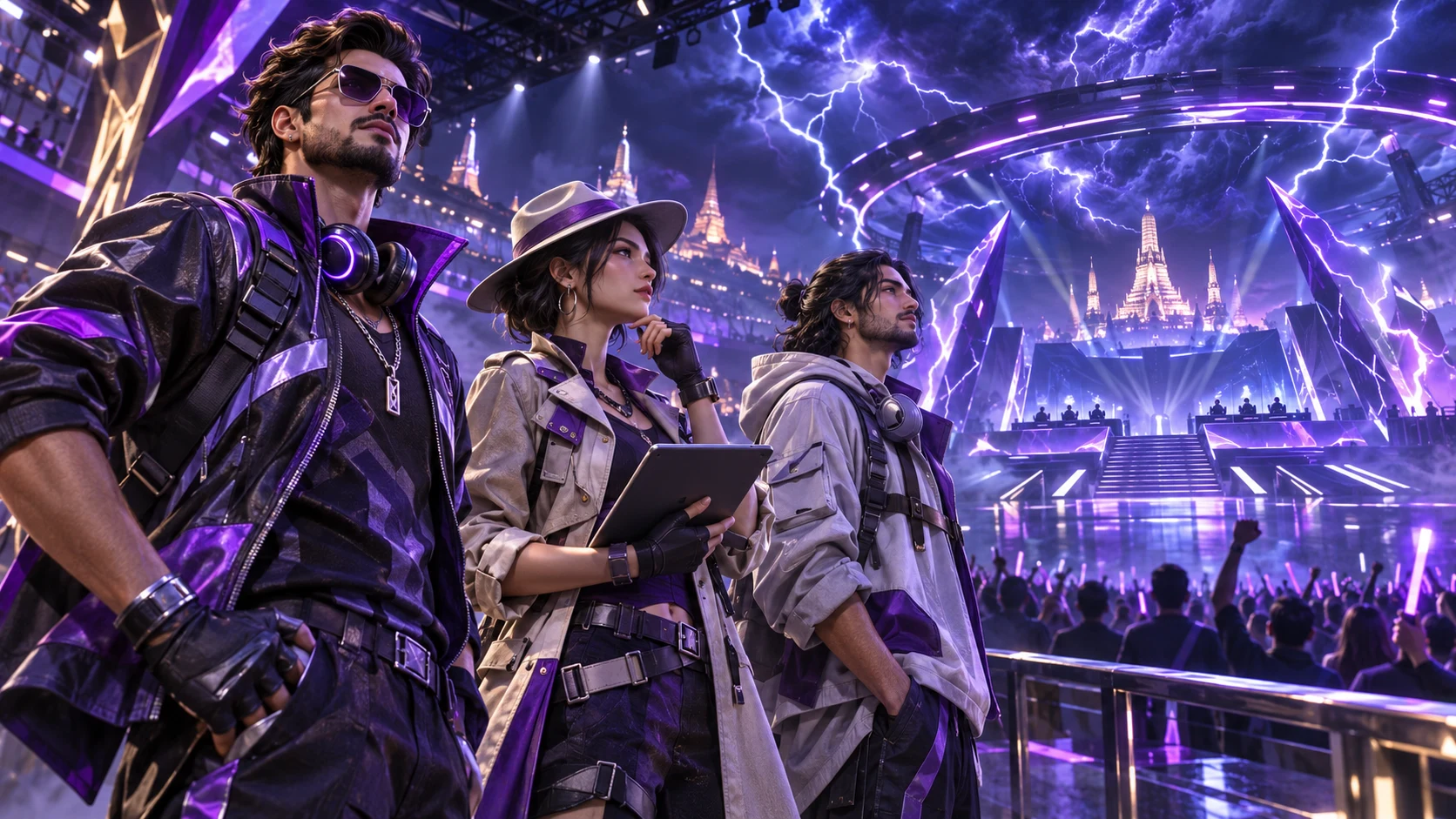
The Free Fire World Series Global Finals 2026 is underway in Bangkok, bringing 24 teams into a month-long competition that ends on 28 November. Garena has paired the tournament with Storm Arena, a global in-game campaign built around the theme “Your Prime Begins in the Storm.” For viewers, the result is more than a single final: it is a sequence of elimination stages, qualification routes and pressure moments worth following from the beginning.
This guide uses Garena’s official announcement and 2026 esports roadmap. It explains the confirmed schedule, how to read each stage, what Champion Rush changes in the Grand Finals, and how the Storm Arena campaign connects players to the event. It does not invent live standings, match results or reward availability. Check the official Free Fire channels for the latest broadcast and in-game status on the day you watch.
Confirmed FFWS Global Finals 2026 Overview
Garena states that the FFWS Global Finals 2026 runs from 6 to 28 November in Bangkok, Thailand. The field has expanded from 18 to 24 teams for the first time, and the announced total prize pool is USD 1.2 million. The Grand Finals are scheduled for 28 November at BITEC LIVE.
The 24 slots represent a broader international field. Garena’s announcement allocates eight places to Southeast Asia, three each to India and Brazil, two each to Bangladesh and Latin America, and one each to Nepal, Pakistan, the United States, MENA and Africa. One additional place belongs to the Esports World Cup champion. That distribution increases the value of comparing regional approaches instead of judging every team by one familiar league.
Garena lists YouTube, Facebook, Kick and TikTok among the streaming platforms, with commentary available in multiple languages. Broadcast availability can differ by region or matchday, so use the official Free Fire esports channels and current event posts rather than an unofficial restream.
The Four Tournament Stages
Knockout Stage 1: 6–15 November
All 24 teams compete in a round-robin structure across two weeks. After play concludes on 15 November, the bottom four teams are eliminated. Early matchdays therefore matter even when they do not immediately produce finalists. A team that consistently gathers placement and elimination value can build protection against one poor day, while repeated low finishes create pressure before the cutoff.
Knockout Stage 2: 19–22 November
Garena says 12 teams compete each day and two advance daily. For viewers, this stage rewards careful attention to the day’s participating field. Do not compare a team’s raw total with a team that played a different schedule without checking the format. Watch who converts strong starts into qualification and who must return for another chance.
Last Chance: 27 November
Twelve teams enter the Last Chance stage, with four places available in the Grand Finals. This is a concentrated qualification day: every rotation, resource decision and late-game conversion has immediate consequences. The safest way to follow it is to track the qualification line after each match rather than focusing only on the match winner.
Grand Finals: 28 November
The finalists meet at BITEC LIVE under Champion Rush, with no fixed match limit announced in Garena’s event article. The competition continues until the Champion Rush winning conditions are met. That makes the final different from a simple “highest score after a preset number of games” event.
How to Watch Knockout Stage 1 More Carefully
On 11 November, Knockout Stage 1 is still in progress. The official schedule places its conclusion on 15 November, so any standings seen before that date are provisional. A good viewer separates a team’s current position from its actual qualification outcome.
- Track consistency: Note how often a team reaches a playable late game, not just how many matches it wins.
- Watch contested drops: Early fights can produce quick points, but they can also damage both teams across several rounds.
- Compare route flexibility: Strong teams often need an alternate path when another squad blocks their preferred rotation.
- Observe resource timing: Utility saved for the final circles may be worth more than an unnecessary mid-game fight.
- Read the cutoff: Focus on the gap around the bottom-four elimination line as 15 November approaches.
A single highlight can show mechanical brilliance without revealing tournament control. Keep a small note of placement, eliminations, survival decisions and repeated mistakes. That makes the broadcast easier to understand and avoids treating one dramatic clip as a complete performance review.
Champion Rush Changes the Final-Day Story
Champion Rush creates a threshold-based championship race. The exact live threshold and scoring display should be taken from the official broadcast, because tournament rules and on-screen status are the authoritative sources. Once a team becomes eligible, winning a later match can end the event. Until that happens, the Grand Finals can continue.
This format creates two separate questions: which team has accumulated enough value to become eligible, and which eligible team can convert a match into a championship win. A squad may lead the overall standings but still need the decisive victory. Another eligible team can suddenly become the central threat when it reaches the final circle.
A viewer’s Champion Rush checklist
- Identify when the official broadcast marks a team as Champion Rush eligible.
- Track how many eligible teams remain alive during each late game.
- Watch whether non-eligible teams challenge the leaders or protect their own scoring path.
- Notice when eligible teams change tempo and take fewer unnecessary risks.
- Wait for the official result graphic before declaring the champion.
The no-match-limit structure is part of the tension. Avoid predicting an exact finishing time. The tournament ends when the rules produce a champion, not when an unofficial schedule estimate says it should.
Storm Arena: The In-Game Connection
Garena launched Storm Arena on 6 November alongside the FFWS Global Finals. The campaign turns the tournament’s “Reach Your Prime” concept into an in-game storm-themed experience. According to the official announcement, players can build Storm Reputation through match performance and unlock Player Cards across five named stages: First Time, Big Time, Show Time, Peak Time and Prime Time.
The Player Cards can feature performance highlights, medals and achievement statistics, with customization options such as team badges, poses and decorations. Garena also announced localized caster voice lines in eight languages: Thai, Indonesian, Vietnamese, Malay, Hindi, Bengali, Arabic and Portuguese.
Storm Arena also introduces the Cosmic Overlord Bundle, described by Garena as a storm-inspired evolution of the Dark Matter Bundle. Treat all missions, cosmetics and rewards as time-sensitive. Check the current in-game event page before planning play sessions or assuming an item remains available.
Use the campaign to improve viewing
Instead of treating the campaign and broadcast as unrelated, compare what you experience in matches with the decisions professionals make. Watch how top teams manage open-ground pressure, preserve utility, choose fights and move under shrinking-zone conditions. The goal is not to copy a professional route without context; it is to learn what information influences their choices.
A Three-Layer Match-Reading Method
Layer 1: Opening plan
Identify each team’s landing area and whether the drop is uncontested. If two teams repeatedly meet early, note who changes route, who remains committed and how much time or equipment the fight costs.
Layer 2: Mid-game movement
Follow the timing of rotations rather than only the destination. An early rotation may secure space but reduce looting time. A late rotation may preserve resources yet create difficult entries. Watch which squads use vehicles, terrain or information to reduce exposure.
Layer 3: Late-game conversion
In the final circles, count surviving players, useful cover and remaining utility. A four-player squad with poor terrain is not automatically safer than a smaller team with strong cover and good timing. Look for coordinated focus fire, controlled spacing and patient use of Gloo Walls.
This method works across regions because it evaluates decisions instead of stereotypes. It also helps newer viewers understand why a team can play well without winning the individual match.
Common Viewer Mistakes
- Using unofficial dates: Garena’s current announcement is the source for the 6–28 November event window and stage dates.
- Calling provisional standings final: Knockout Stage 1 is not complete until 15 November.
- Judging only Booyahs: Tournament progress also depends on consistent scoring and survival decisions.
- Assuming a fixed final length: Champion Rush has no match limit in the announced Grand Finals format.
- Inventing reward guarantees: Verify Storm Arena missions and availability inside the current game client.
- Trusting fake streams: Use official Free Fire channels and links for broadcasts and event information.
Be cautious with posts promising free diamonds, exclusive codes or guaranteed rewards for entering a password. A legitimate viewing activity should not require your game-account password, social-login credentials or one-time code.
Prepare for Each FFWS Weekend
- Check the official Free Fire announcement or social channel for the day’s broadcast link.
- Confirm which stage is active and which teams are scheduled.
- Open a simple note with columns for rotations, fights, placement and late-game decisions.
- Mark the cutoff or qualification line shown by the official broadcast.
- Review one strong decision and one recoverable mistake after the matches.
- Recheck in-game Storm Arena missions separately from tournament standings.
For related reading, see HTG’s FFWS SEA Fall viewer guide, Free Fire esports team roles guide, and drop spot and rotation guide. Those articles explain regional viewing, player responsibilities and map control in more detail.
Final Viewing Plan
The FFWS Global Finals 2026 is best understood as a progression. Knockout Stage 1 narrows the 24-team field after 15 November. Knockout Stage 2 qualifies teams from 19 to 22 November. Last Chance awards four final places on 27 November, and Champion Rush decides the world champion at BITEC LIVE on 28 November.
Follow the official broadcast, treat interim standings as provisional and watch how teams solve repeated problems. Storm Arena can make the event feel closer to the game, but the competition itself is read through rotations, resource control, late-game execution and the pressure of Champion Rush.
Top Up Your Favourite Games
If you're looking for a trusted place to top up your favourite games including Free Fire, PUBG Mobile, Mobile Legends, Blood Strike, and Call of Duty, visit HTGTopUp.com for fast digital game top-up services. Website: https://htgtopup.com.