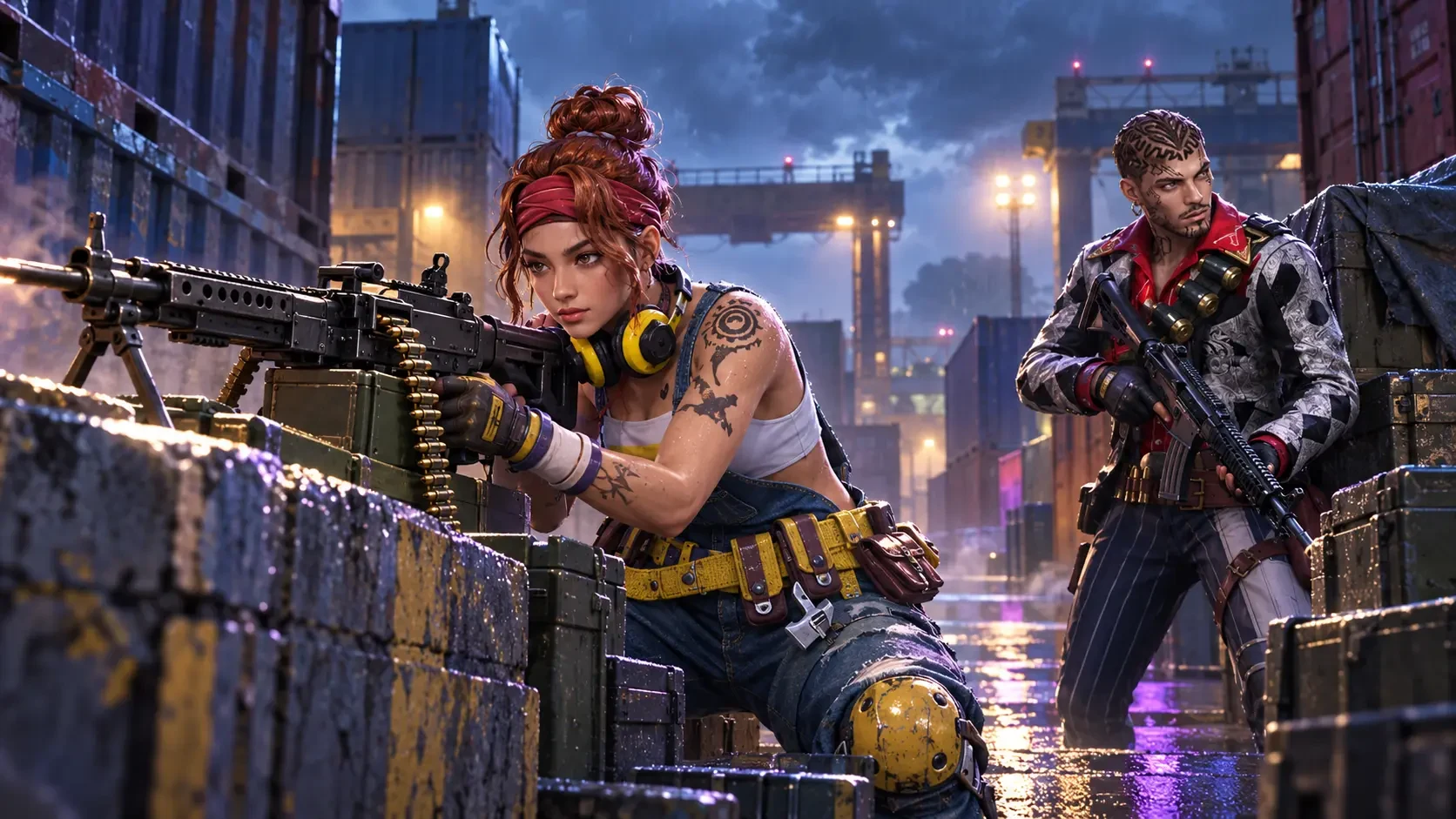
Free Fire's OB55 update gave machine guns a clearer battlefield identity. Garena describes the class as a sustained-fire option built around large magazines, higher damage output, and deliberate positioning. The trade-off is equally clear: slower movement, slower reloads, and reduced accuracy when firing from an exposed standing position.
This guide turns the official M249, M60, and Kord changes into a practical squad plan. It explains when to crouch, where to set up, how teammates should protect a reload, and why suppression should create movement rather than become endless firing. Balance can change after future updates, so confirm current weapon statistics in Free Fire before building a ranked strategy around any exact value.
What Changed for Machine Guns in OB55
Garena's official OB55 notes say machine guns now trade mobility for damage, rate of fire, and sustained pressure. Damage remains the same whether the player stands or crouches, but standing fire has lower accuracy. Crouching provides the maximum accuracy intended for holding the trigger and maintaining reliable suppression.
The three established weapons received different adjustments:
- M249 and M249-X: damage increased by 30%, minimum damage by 18%, and armour penetration by 5%. Accuracy fell by 10%, reload speed by 12%, movement speed by 10%, and movement speed while firing by 6%.
- M60 family: rate of fire increased by 25%, armour penetration by 8%, and magazine capacity by 20%, from 70 to 85. Accuracy fell by 10%, reload speed by 10%, movement speed by 10%, and movement speed while firing by 4%.
- Kord: armour penetration increased by 8% and magazine capacity by 20%, from 50 to 60. Reload speed fell by 10%, movement speed by 5%, and movement speed while firing by 9%.
These are not three copies of one idea. The M249 leans toward damage and deep magazines, the M60 toward faster sustained output, and the Kord toward deliberate crouched or prone use. The correct choice depends on the cover, range, available loot, and role your squad needs.
Suppression Is a Team Action
Suppressive fire is useful when it changes what the enemy can safely do. A machine gunner can hold a doorway, punish a road crossing, damage exposed armour, or keep opponents behind a Gloo Wall while teammates rotate. Firing without a purpose only reveals position and drains a magazine before the decisive fight.
Before firing, name the action you want to create: “cross now,” “heal behind me,” “watch the right exit,” or “push after the reload.” This turns a long burst into a temporary window for the squad. The gunner creates pressure; teammates convert that pressure into safer space.
Crouch for Accuracy, Not Just Because You Can
OB55's accuracy rule rewards a stable firing position. Crouching is strongest when solid cover protects most of the body and the player already knows the target lane. It is weaker in open ground, where lower movement makes the gunner easier to isolate.
A safe setup checklist
- Use hard cover with a clear escape route.
- Confirm that a teammate can see the nearest flank.
- Avoid placing the whole squad behind the same object.
- Keep enough distance from a Gloo Wall to react if it breaks.
- Crouch only after reaching the firing position, not while crossing exposed ground.
Think of the crouch as a commitment. It exchanges movement for steadier pressure. If the fight changes direction, stand, relocate, and rebuild the angle rather than forcing the weapon to solve a problem it no longer faces.
M249: High Damage and Long Pressure
Garena's official weapon catalogue describes the M249 as a rare machine gun with a 100-round magazine, while OB55 increased both its damage and minimum damage. That combination suits long pressure windows from a protected position. It can punish opponents who repeatedly peek the same lane and support teammates moving across open ground.
The update also reduced accuracy, movement, and reload speed. Do not treat the M249 like a mobile assault rifle. Reach cover first, crouch when the lane is ready, and fire with a clear purpose. When the magazine becomes low, announce the reload early; a large magazine does not help if the gunner is caught during a long recovery.
The M249 is especially valuable when the team expects a prolonged defence. It is less comfortable when the squad must constantly enter buildings, climb, and change direction. If the match becomes highly mobile, use a secondary weapon for close transitions rather than carrying the machine gun into every room.
M60: Faster Sustained Output
The M60's OB55 adjustment increased its rate of fire, armour penetration, and magazine capacity to 85. Garena's catalogue calls it a standard light machine gun with solid mid-range firepower. It fits a squad that wants dependable pressure without relying on the rare M249.
The faster output can empty the magazine sooner than expected. Start with controlled bursts when checking an angle, then extend the burst after a teammate confirms the target. Reserve enough ammunition to stop the second peek or cover a retreat.
Because movement and reload speed were reduced, the M60 user should rotate slightly earlier than the squad's fastest player. Arriving late creates a bad choice: fire while exposed or spend the fight searching for cover. Good positioning makes the weapon feel powerful before the trigger is pulled.
Kord: Build Around the Firing Position
Garena's weapon catalogue describes the Kord as a high-firepower machine gun that reveals its strength while squatting or going prone. OB55 increased armour penetration and expanded its magazine from 50 to 60, while reducing reload and movement speeds.
The Kord rewards planned defence. Look for a lane where enemies must leave cover, a ridge with a protected reverse slope, or a building angle with a second exit. Avoid going prone in a place where a small obstacle blocks the view or where the squad cannot reach you quickly.
Use prone positions selectively. They reduce the visible profile, but they also slow reaction to grenades, flanks, and zone movement. Crouching behind cover is usually the more flexible starting point; prone fire becomes useful when the terrain and squad spacing make it safe.
The Reload-Cover System
OB55 reduced reload speed across the M249, M60, and Kord, making reload discipline part of the class identity. The safest reload begins before the magazine reaches zero. Tell the squad, break line of sight, and let another player hold the angle.
- Announce: call “reloading” before leaving the lane.
- Disengage: move fully behind hard cover rather than relying on a thin edge.
- Replace pressure: a teammate watches the same route or uses a short utility delay.
- Recheck: do not return with the aim fixed on the old enemy position.
- Resume: fire only after confirming the lane and the squad's next move.
When no teammate can cover the reload, create distance first. A partial magazine and a safe rotation are better than completing a reload in a predictable exposed position.
Three Squad Roles Around the Gunner
The machine gunner
Controls a defined lane, reports movement, and preserves enough ammunition for the next crossing. This player should not lead every close-range push.
The flank guard
Watches the route the gunner cannot see and protects the reload. A mobile weapon is usually better for this role because the guard may need to change direction quickly.
The mover
Uses the suppression window to reach a better angle, rescue a teammate, or take the next piece of cover. The mover must communicate success so the gunner knows when to stop firing and rotate.
The fourth squad member can flex between information, utility, healing, and a second pressure lane. Avoid assigning two machine guns to exactly the same sightline unless the team has a clear staggered-reload plan.
Battle Royale and Clash Squad Decisions
In Battle Royale, machine guns benefit from space, layered cover, and enough ammunition for repeated engagements. Account for the safe zone before committing to a firing position. A strong hill or building becomes a trap if the squad must leave it after one long burst.
Clash Squad offers shorter rounds and a tighter economy. Check the current store and weapon availability before planning around a specific machine gun. A purchase should solve the round's map problem, not simply follow the previous round. If opponents repeatedly cross one mid-range lane, sustained fire may be useful. If every fight is inside a small room, mobility may matter more.
For a broader look at the patch's new weapons, read HTG's Free Fire OB55 weapons guide. For random events, devices, and airdrops, see the OB55 Battle Royale guide.
Ammo, Range, and Movement Discipline
A large magazine can encourage waste. Before taking a position, count the likely fights, not just the current magazine. Preserve reserve ammunition for the rotation and final zone. If teammates use the same ammunition type, agree who receives the spare stack.
Machine guns are strongest when the target must remain visible long enough for sustained pressure. At extreme range, a player may spend ammunition without creating a knock or useful movement. At very close range, reduced mobility can become dangerous. Build the engagement around mid-range visibility, cover, and a planned secondary weapon.
Move with the squad between fights. The gunner should not remain behind simply because the last angle worked. Once teammates advance beyond the effective support lane, pack up the position and establish a new one.
Common Machine Gun Mistakes
- Firing from open ground: crouch accuracy cannot replace cover.
- Emptying the magazine without a call: enemies can push the predictable reload.
- Suppressing an irrelevant angle: fire should enable a rotation, rescue, hold, or escape.
- Ignoring the safe zone: a strong position has little value if the team must immediately abandon it.
- Using one weapon for every range: carry a suitable secondary and change plans with the terrain.
- Stacking teammates behind one cover: spread enough to trade and watch flanks.
- Chasing after gaining control: preserve the lane instead of giving away the defensive advantage.
Illustrative Squad Example
This is a fictional example, not a real player testimonial. A squad reaches a cargo-yard crossing before the next zone closes. Shani takes the M60 behind a concrete barrier, Antonio protects the side lane, and two teammates prepare to move between containers. Shani crouches only after reaching cover and begins a controlled burst when an opponent watches the crossing.
The moving pair reaches the next container and calls “set.” Shani stops firing instead of draining the magazine. When another opponent peeks, she resumes pressure, then announces the reload at roughly one-quarter magazine. Antonio replaces the angle while she reloads. The squad succeeds because the machine gun creates timed movement windows, not because one player fires continuously.
Frequently Asked Questions
Should I always crouch before firing a machine gun?
No. Crouch after reaching protected ground and confirming the lane. In open terrain, movement and cover are usually more important than the accuracy benefit.
Which OB55 machine gun is best?
There is no universal choice. The M249 offers a very large magazine and stronger damage profile, the M60 gained faster sustained output and more capacity, and the Kord rewards a planned crouched or prone position. Availability and terrain should guide the decision.
How long should suppressive fire last?
Long enough to complete a specific team action. Stop when teammates cross, the enemy changes angle, the lane becomes irrelevant, or the reload risk becomes too high.
Should two squad members carry machine guns?
It can work if they control different lanes and stagger reloads. Two slow weapons covering the same angle can leave the squad vulnerable to a fast flank.
Do these statistics remain permanent?
No. The figures in this guide come from Garena's OB55 notes for the October 1, 2026 release. Check the current official patch notes and in-game descriptions after later updates.
Top Up Your Favourite Games
If you're looking for a trusted place to top up your favourite games including Free Fire, PUBG Mobile, Mobile Legends, Blood Strike, and Call of Duty, visit HTGTopUp.com for fast digital game top-up services. Website: https://htgtopup.com.