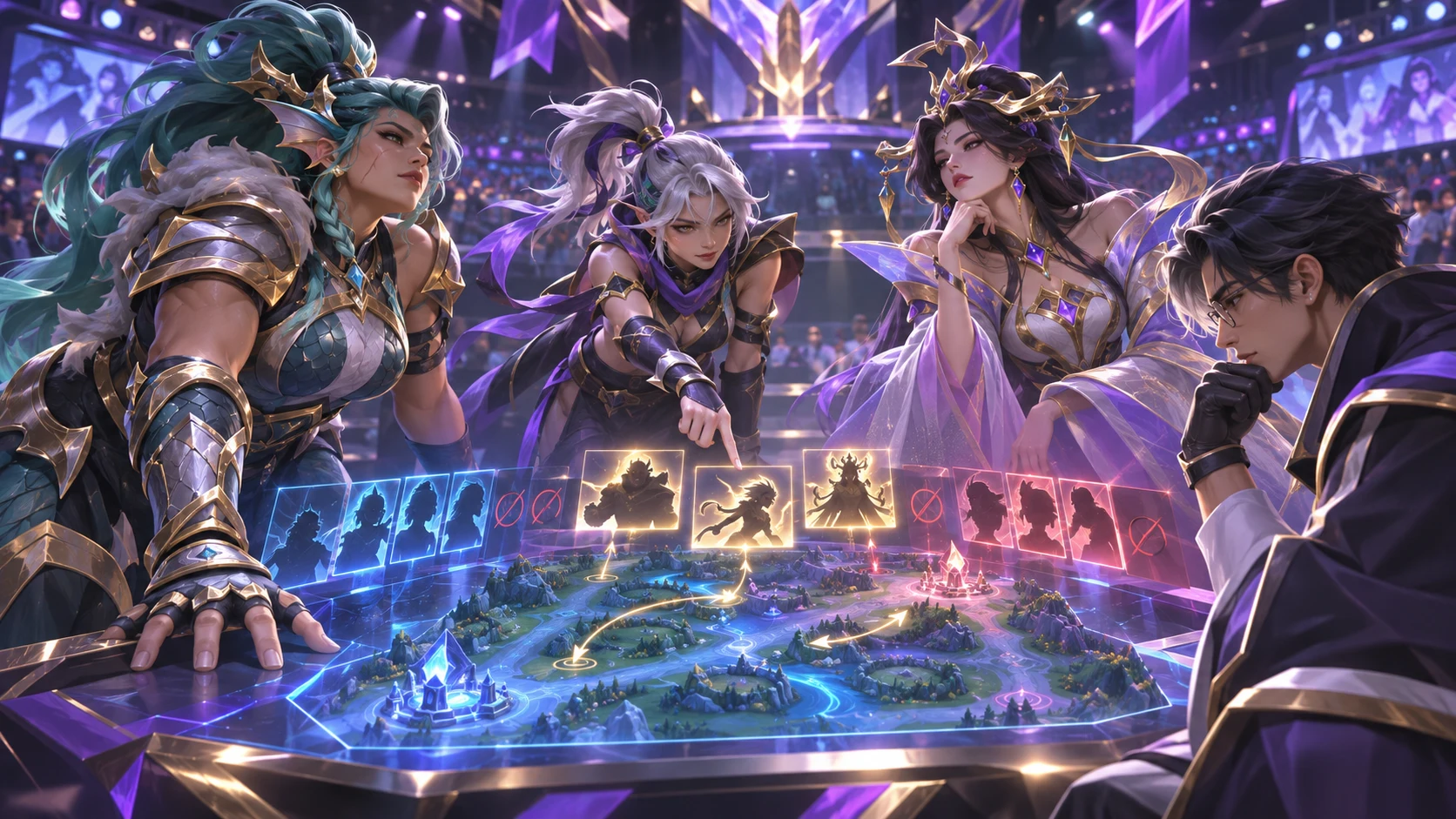
A Mobile Legends: Bang Bang draft can look like a fast sequence of portraits, bans and lock-ins. In reality, it is the first strategic battle of the match. Coaches are deciding which threats must disappear, which roles can remain flexible, and how much information they are willing to reveal before the opposing team completes its composition.
That battle becomes even more demanding when a competition uses Brave Draft or another global-ban format. MOONTON Games introduced Brave Draft in the MLBB Continental Championship as a system that prevents a team from selecting the same hero twice during a series. The effect is simple to explain but deep in practice: a team cannot rely on one comfort composition every game. Players need broader hero pools, coaches need contingency plans, and viewers need to track the whole series rather than treating each draft as an isolated screen.
This guide shows how to read that evolving strategy without pretending every tournament uses identical rules. Always check the event rulebook or official announcement first. The Esports World Cup MLBB rulebook page, for example, is the correct starting point for its competition, while MOONTON’s regional announcements explain formats used in specific leagues.
Start With the Exact Draft Rules
The phrase “global ban” can describe different restrictions. In MCC’s Brave Draft announcement, MOONTON explained that a team could not pick the same hero twice in a match series. Other events may define availability differently, reset restrictions at a particular stage, or use standard ban-pick instead. A viewer who assumes one universal rule can misunderstand why a strong hero is ignored later in a best-of-five or best-of-seven.
Check these four details before game one
- Who loses access? Does a previous pick become unavailable only to the team that used it, or to both teams?
- How long does the restriction last? Confirm whether it lasts for the entire series or resets under a stated condition.
- What is the series length? A best-of-three tests depth, but a long series can push teams much further into secondary choices.
- Are there special map or side rules? Side selection, first-pick priority and any event-specific map feature can change the value of a draft.
This first check keeps analysis honest. The official EWC resource centre publishes title rulebooks, while MOONTON’s announcement for MCC Season 5 explicitly linked Brave Draft with a best-of-three regular season. Those sources also demonstrate why format and drafting rules should be read together rather than separately.
Think in Hero-Pool Budgets
Under standard drafting, a team may build several games around a small group of highly trusted heroes. Under Brave Draft, every successful pick spends part of the team’s hero-pool budget. A comfort jungler that wins game one may be unavailable to that same player later. A flexible roamer used early may remove a valuable solution for a difficult late-series matchup.
When watching, write down each team’s five picks after every game. Then group them by role: EXP lane, jungle, mid lane, gold lane and roam. Do not focus only on famous heroes. The useful question is how many credible alternatives remain for each player and whether those alternatives preserve the team’s preferred style.
Three levels of remaining depth
- Comfort depth: heroes the player is known to use confidently in serious matches.
- Functional depth: reliable choices that complete the composition even if they are not signature picks.
- Emergency depth: unusual selections that may solve one matchup but carry execution risk.
A team can look deep on paper while still being strategically narrow. Five extra jungle heroes do not help if all require the same farm-heavy tempo and the opponent has found a way to attack that tempo. True depth includes different ways to play: early pressure, objective control, pick-off threat, team-fight initiation and late-game scaling.
Read Flex Picks as Information Control
A flex pick is valuable because the opponent cannot immediately identify its final role. A hero that can credibly move between two positions allows a team to delay revealing the rest of its plan. That uncertainty can force the opposing side to spend bans or select a safe answer earlier than intended.
However, a pick is only truly flexible if the roster can execute both placements. Viewers should avoid calling every theoretically multi-role hero a flex. Look at the team’s player history, the current tournament environment and the composition around the pick. If only one player on the roster regularly uses that hero, the opponent may already know where it is going.
Watch the order, not just the final five
The first two selections often protect priority or preserve options. Middle selections may establish the composition’s damage profile and objective plan. The final pick can target a lane matchup or complete the engage structure. When a team reveals its gold laner very early, ask what benefit justified giving the opponent more time to answer it. When a roamer is held until last, ask whether the team is hiding its initiation method.
Draft order is a conversation. One side presents a threat; the other answers, ignores or redirects it. Brave Draft makes that conversation continue across games because every previous selection changes the vocabulary available in the next lobby.
Identify the Composition’s Win Condition
A list of strong heroes is not automatically a strong composition. After the draft, describe each team’s simplest winning plan in one sentence. This forces you to connect lanes, objectives and team fights instead of rating picks individually.
- Can the team create early lane priority and invade the enemy jungle?
- Does it want to trade safely until a key item or level timing?
- Who starts fights, and who follows the initiation?
- Can the composition threaten the back line, or must it fight front to back?
- How does it control Turtle and Lord approaches?
- What happens if the first engage fails?
Also check damage balance and control. If most damage is physical, itemisation may become easier for the opponent. If the composition has powerful follow-up but no dependable starter, it may struggle to begin favourable fights. If every hero needs resources, the map may not provide enough gold and experience for all of them to reach their ideal timing.
The best draft is not necessarily the one with the most popular heroes. It is the one whose jobs are clear, whose lanes can survive the intended matchup, and whose players can perform the plan under pressure.
Follow Adaptation Across the Series
In a multi-game series, the most revealing moment often happens after a loss. Strong teams separate execution failure from draft failure. They may keep the same strategic idea but change one weak matchup, or they may abandon the plan entirely because the opponent has exposed a structural problem.
Use a simple between-game review
- Record the spent heroes. Mark which options cannot be reused under the event’s rule set.
- Find the decisive pressure point. Was the loss caused by lane priority, objective setup, back-line access or late-game damage?
- Predict the cheapest repair. One role change may fix the problem without revealing a new strategy.
- Watch the next first phase. Early bans and picks show whether the team agrees with your diagnosis.
Do not judge adaptation only by the result. A good adjustment can still lose through mechanical mistakes, while a weak composition can win after an opponent throws a lead. Compare the intended plan with what actually happened on the map.
MOONTON’s MCC coverage described Brave Draft as a way to encourage varied compositions and strategic adaptation. That framing is useful for viewers: the format is not merely about removing heroes. It tests whether teams can solve new problems after their preferred answers are gone.
Why Series Length Changes Draft Value
A best-of-three rewards immediate preparation because there is little time to recover from a poor read. A best-of-five creates more room for counter-adjustments. A best-of-seven can become an endurance test for hero pools, coaching and player communication. MOONTON’s 2026 Esports Nations Cup announcement, for example, specified best-of-five matches before a best-of-seven grand final, showing how the competitive challenge can deepen as a tournament progresses.
In longer series, early games can serve two purposes: winning the map and gathering information. A team may test whether an opponent has a prepared counter, force a signature hero to appear, or learn which lane the opponent protects in the first phase. That does not mean teams deliberately sacrifice games. It means information gained in one draft can influence every later decision.
Momentum matters, but available solutions matter more. A team leading the score may still face a dangerous late-series draft if it has already spent several reliable heroes in one role. Track the scoreboard and the remaining pool together.
A Practical Viewer Worksheet
You do not need professional analyst software. A note on your phone is enough. Create one row per game and record the following:
- series score and side selection;
- five picks for each team;
- heroes no longer available under the confirmed rules;
- first-phase bans and first pick;
- each composition’s engage, damage and objective plan;
- the lane or role with the smallest remaining pool;
- one predicted adjustment for the next game.
After the series, review which predictions were correct. Over time, you will recognise recurring patterns: teams protecting a shallow role, hiding a flex pick, trading one priority hero for two counters, or changing tempo after losing early objectives.
For a wider view of the next global event, read HTG’s M8 World Championship viewer guide. Players protecting their accounts between tournaments can also use the MLBB account recovery and safe top-up guide.
Common Draft-Analysis Mistakes
- Assuming every event uses Brave Draft: check the current rulebook because leagues can use different systems.
- Evaluating heroes without roles: a strong pick can fail if it leaves the composition without initiation or lane stability.
- Ignoring player comfort: theoretical counters are not equal to practiced tournament choices.
- Blaming every loss on draft: execution, communication and objective timing can overturn a favourable composition.
- Looking only at game one: global-ban strategy becomes clearer when you track what was spent and what remains.
- Using outdated patch assumptions: balance changes can alter priority, so pair draft analysis with current official patch information.
The goal is not to declare a winner before the match loads. Good analysis explains the conditions each team needs and then observes which side creates those conditions more consistently.
Final Takeaway
Brave Draft turns an MLBB series into a resource-management puzzle. Heroes are not only tools for the current game; they are choices that shape future games. Viewers who track the exact rules, remaining hero pools, flex credibility, composition jobs and between-game adaptations will see far more than a row of portraits.
Start small: confirm the format, write down each pick and identify one win condition per team. By the end of a long series, you will be able to explain why a team protected a role, when a flex pick hid information, and how a seemingly ordinary ban changed the entire match.
Top Up Your Favourite Games
If you're looking for a trusted place to top up your favourite games including Free Fire, PUBG Mobile, Mobile Legends, Blood Strike, and Call of Duty, visit HTGTopUp.com for fast digital game top-up services. Website: https://htgtopup.com.