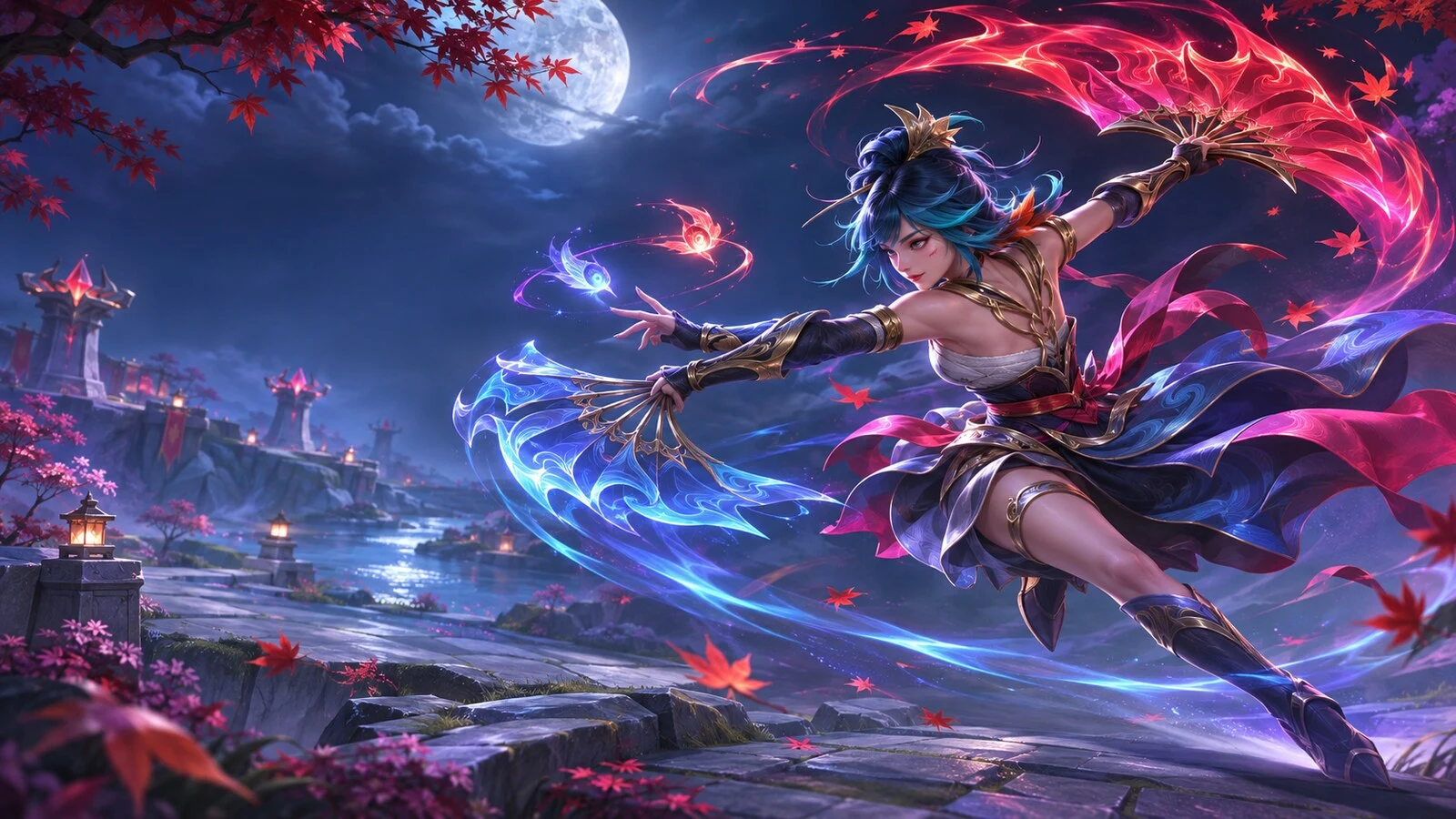
Hirara rewards players who can make two decisions at once: where to move and which fan to use next. Unlike assassins built around a long row of separate buttons, she uses two base skills that can be dragged onto one another to create combo skills. That compact design makes her look simple, but it places unusual weight on input order, Crimson Energy and route planning.
This guide explains the official mechanics behind Hirara and turns them into a practical learning plan. It avoids patch-dependent item promises and focuses on habits that remain useful: clean skill drags, patient energy management, prediction and safe exits.
What Makes Hirara Different?
Mobile Legends officially classifies Hirara as an Assassin with Chase and Finisher strengths. Her passive, Twin Fans: Ukifune, gives her only two normal skills, each linked to a different fan. The important twist is that either skill can be dragged onto the other to trigger a combo skill.
That means the order is meaningful. Pressing a skill by itself, dragging the first fan into the second, and reversing that drag are not interchangeable inputs. A good Hirara player therefore thinks in short sequences rather than isolated cooldowns.
The three resources you are really managing
- Position: where Hirara will be after her movement or attack ends.
- Cooldowns: whether a base fan is available for the next step.
- Crimson Energy: whether she can spend an energy point on a combo skill.
The official hero description says Hirara has two Crimson Energy points, sometimes described as Death Energy. A combo consumes one point. Energy recovery is tied to the cooldown of Meisen-e, and spending energy interrupts that recovery. This makes reckless back-to-back combinations costly even when they look mechanically impressive.
Learn the Two Base Skills First
Before practising combined inputs, build confidence with each fan on its own. The goal is to understand what a single button can achieve so you do not spend energy to solve a problem that a base skill already handles.
Meisen-e: movement with intent
According to the official skill page, Meisen-e allows up to two joystick-directed dashes. Treat those dashes as positioning tools, not a command to move forward twice. One dash can adjust the angle, while the next can close distance, cross to a safer side or preserve an escape route.
Practise changing direction between the two movements. In a real fight, the shortest line to a target is often the most predictable line for enemy crowd control. A curved approach can reveal more information and leave Hirara on the edge of danger instead of in its centre.
Kaerazu: aim for the next position
Kaerazu deals damage in a fan-shaped area, then repeats after a delay at the target location described by the official skill information. The delayed part rewards prediction. Aim where an opponent is likely to move, especially near a wall, objective entrance or retreat path.
The second hit also creates useful pressure. Even if an enemy avoids it, the threatened area can influence their route. That can buy space for your team without requiring Hirara to chase every target into unsafe ground.
How to Think About Twin-Fan Combos
Hirara’s defining input is a drag from one skill onto the other. Learn both directions in the Training Camp and read the current in-game descriptions, because exact values can change with balance updates. The durable lesson is that the first fan expresses your opening intention and the second completes the combined action.
Use a simple decision question
Before dragging, ask: What must happen after this combo? If the answer is “escape,” do not spend the movement and energy that make the exit possible. If the answer is “finish,” confirm the opponent is actually vulnerable and that nearby enemies cannot immediately trade you.
- Use a base skill when one action is enough.
- Use one combo when it creates a clear positional or finishing advantage.
- Keep one energy point when the fight is still uncertain.
- Spend both only when the second action has a defined purpose.
This discipline prevents a common assassin failure: winning the first second of a fight but having no answer for the next three.
Crimson Energy Is a Safety System
It is tempting to view two energy points as permission to cast two combos immediately. A stronger interpretation is that the second point is insurance. It lets Hirara react when an enemy changes direction, receives help, survives longer than expected or forces her to disengage.
Because spending energy interrupts its recovery, hurried chains delay the moment when your options return. Pause whenever the situation allows. A brief reset can be more valuable than a low-probability extra hit.
A practical energy rule
- Two points: look for information and a favourable opening.
- One point: commit only if the remaining action covers the finish or exit.
- Zero points: stop behaving like a fully armed assassin; reposition and recover.
Watch the battlefield rather than only the energy display. If the enemy roamer is missing, your second point may be the only thing protecting you from an unseen counter-engage.
A Safer Assassination Sequence
Hirara works best when the preparation happens before the dash. Use this repeatable sequence to reduce unnecessary risks.
- Identify the target. Prefer an exposed damage dealer or weakened enemy over the closest hero.
- Count visible threats. Note hard crowd control, defensive skills and enemies missing from the map.
- Choose an exit landmark. A bush, wall edge, allied front line or open lane can become the return path.
- Approach at an angle. Preserve at least one movement option instead of using everything to enter.
- Confirm the opening. Enter after a key defensive tool is used or when an ally creates pressure.
- Reassess after the first action. Continue only if the target remains finishable and the exit is still available.
This is less flashy than automatic chaining, but it produces cleaner decisions. Assassins create value through threat and timing, not merely by touching the back line first.
Teamfight Timing and Map Awareness
Hirara should rarely be the first hero seen in a full teamfight. Let the front lines reveal positions and force important abilities. Entering from fog or a side angle makes her mobility harder to read and reduces the number of enemies who can respond together.
Before a major objective, do not spend both energy points on speculative poke. Arrive with options. If your team already controls the entrance, hold a flank that threatens the enemy damage dealer without separating so far that allies cannot help.
Signals that favour an entry
- An enemy control skill has just missed or been used on your tank.
- The intended target steps away from their support.
- Your team has vision of the heroes who could punish the dive.
- The target is moving through a narrow path where Kaerazu’s delayed area matters.
- You have enough health, energy and movement to leave after the attempt.
For broader map fundamentals, pair this approach with HTG’s Mobile Legends roaming guide. Understanding how roamers create vision and absorb control helps an assassin recognise the safest entry window.
Five Mistakes That Slow Hirara Players Down
1. Dragging before deciding
Fast hands cannot repair the wrong sequence. Decide whether you need movement, pressure, a finish or an exit before starting the drag.
2. Using both Meisen-e dashes in one direction
The second direction is an opportunity to dodge, change the attack angle or disengage. Repeating the first line makes the movement easier to predict.
3. Aiming Kaerazu at the current position
The delayed repeat rewards anticipation. Consider the enemy’s retreat route, nearby cover and likely reaction to your approach.
4. Emptying energy at the start
Two immediate combos may leave Hirara with no flexible answer. Keep one point until the fight’s shape becomes clear.
5. Chasing after the objective is won
A low-health enemy can bait Hirara away from a turret, Lord, Turtle or safe reset. Convert the advantage instead of turning every escape into a personal challenge.
A 15-Minute Hirara Practice Routine
Short, focused repetitions build more reliable inputs than repeatedly entering matches with no training target.
- Minutes 1–3: use Meisen-e without enemies. Change direction between dashes and stop at chosen landmarks.
- Minutes 4–6: cast Kaerazu at a moving target. Predict the destination of the delayed strike.
- Minutes 7–9: practise both drag directions slowly. Accuracy matters more than speed.
- Minutes 10–12: perform one combo, pause and observe energy recovery before the next sequence.
- Minutes 13–15: simulate entry, finish and exit. End every repetition in a preselected safe area.
In your next match, choose one measurement: wrong drag inputs, deaths with zero energy, missed delayed hits or dives without an exit. Review that single number after the match. Narrow feedback makes improvement visible.
Hirara Match Review Checklist
Use the replay to examine decisions rather than only eliminations. A successful finish can still hide a risky habit, while a failed attempt may have started from the correct read.
- Did I know where the main enemy control threat was?
- Did a base skill solve a problem that I used energy to solve?
- Was my Kaerazu placement based on movement prediction?
- Did I preserve an exit before committing?
- Did I stop when energy reached zero?
- Did my actions help secure an objective or only extend a chase?
Over time, the goal is not simply more combos. It is fewer unnecessary combos and a higher percentage of actions that lead to a safe, useful outcome.
Frequently Asked Questions
Is Hirara difficult to learn?
Her two-button layout is compact, but the drag order, energy timing and directional movement create a high decision load. She becomes easier when you practise each base skill before combining them.
How many Crimson Energy points does Hirara have?
The official hero information describes two points. A combo skill consumes one, and energy recovery is connected to Meisen-e’s cooldown.
Should I always use a combo when energy is available?
No. A base skill may be sufficient, while saved energy can protect a later finish or escape. Availability is not the same as necessity.
Why does Kaerazu miss moving targets?
Its damage pattern includes a delayed repeat at the target location. Aim with the opponent’s likely route in mind rather than focusing only on where they are at the first cast.
What should I practise first?
Start with Meisen-e direction changes, then Kaerazu prediction. Add slow, accurate drag combinations only after both base skills feel deliberate.
Can this guide replace current patch notes?
No. This guide teaches decision-making from the official skill framework. Always check the current in-game descriptions and official Mobile Legends updates for balance values or mechanical changes.
Top Up Your Favourite Games
If you're looking for a trusted place to top up your favourite games including Free Fire, PUBG Mobile, Mobile Legends, Blood Strike, and Call of Duty, visit HTGTopUp.com for fast digital game top-up services. Website: https://htgtopup.com.