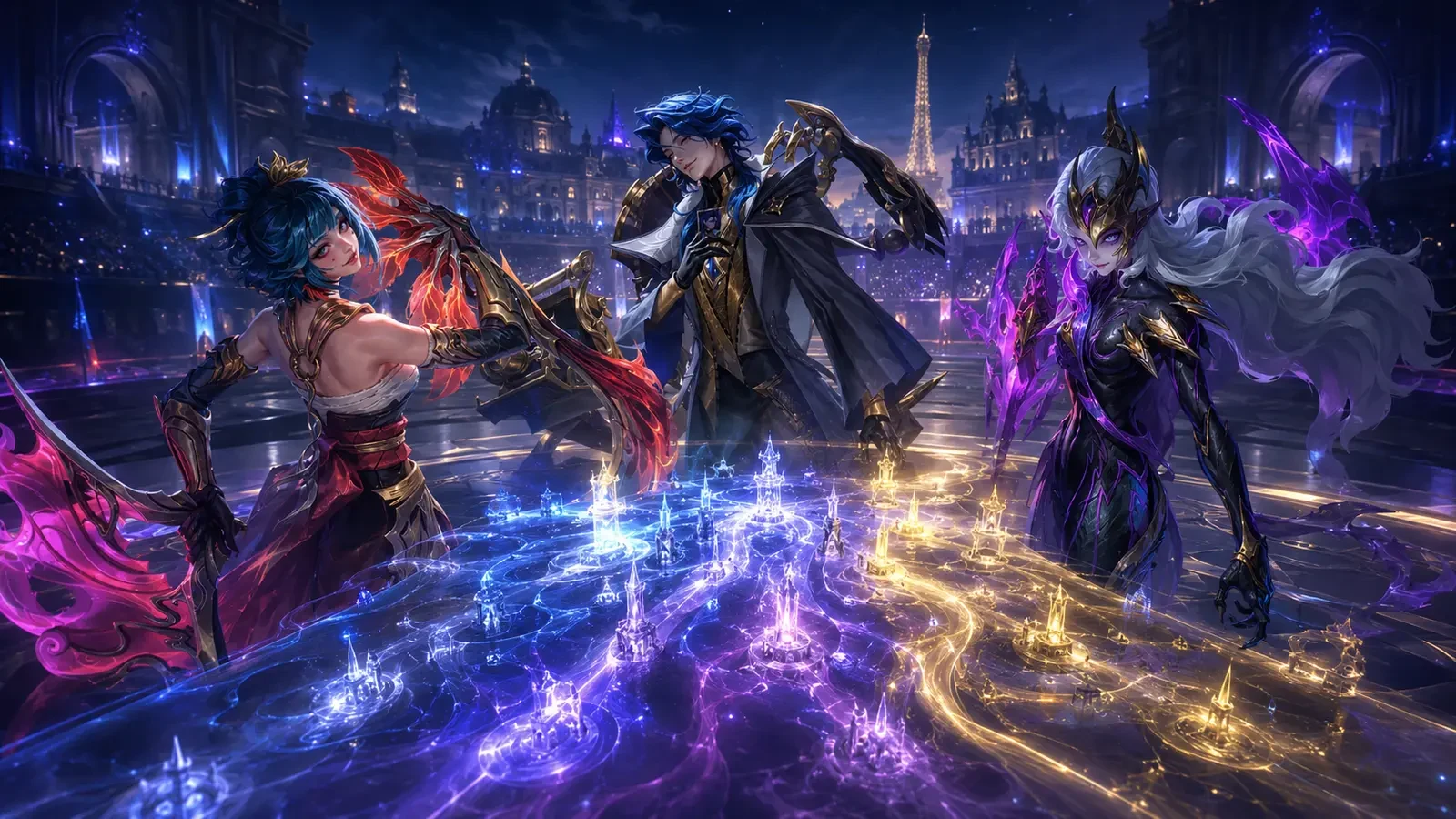
The Mobile Legends: Bang Bang Mid Season Cup 2026 Group Stage is designed to test more than one strong draft. Sixteen teams compete in two groups using best-of-three double elimination, and only four teams from each group move into the Knockout Stage. That format rewards fast adaptation, disciplined preparation and the ability to recover after a difficult series.
This guide explains how to watch those layers clearly. It uses MOONTON Games’ official tournament information for dates and structure, while treating draft and gameplay discussion as viewer analysis rather than unverified claims about live results.
The official MSC 2026 Group Stage structure
MOONTON confirmed that the Main Stage features 16 teams split into two groups. Each group uses a best-of-three double-elimination format, with the top four teams advancing. The Group Stage runs from 22 to 26 July in Paris.
The eight qualified teams then enter a best-of-five single-elimination Knockout Stage from 29 to 31 July. The competition concludes with a best-of-seven Grand Final on 1 August. This creates three distinct tests: survival in BO3 groups, deeper preparation in BO5 elimination matches and endurance in a possible seven-game final.
| Stage | Official format | What it tests |
|---|---|---|
| Group Stage | Two groups, BO3 double elimination | Fast adaptation and recovery |
| Knockout Stage | Eight-team BO5 single elimination | Draft depth and series planning |
| Grand Final | BO7 | Endurance and long-series answers |
Because the tournament was still inside its Group Stage when this article was prepared, readers should confirm current scores through official MLBB Esports or Esports World Cup channels. This guide does not guess which teams have qualified.
How double elimination changes every series
In a standard single-elimination bracket, one series loss ends a team’s run. Double elimination gives a team a second route after its first defeat, but that safety net should not be mistaken for low pressure.
Winning an opening series preserves preparation and provides a cleaner path. Losing sends a team toward elimination matches where every draft must work immediately. A team can recover, but it has less room to test unusual ideas.
Upper-path pressure
Teams on the winning side can focus on securing qualification without first facing an elimination series. Viewers should watch whether they keep using proven structures or reveal extra strategies to close the group quickly.
Lower-path pressure
A team entering the lower path must solve the problem that caused its first loss while preparing for a new opponent. That makes coaching decisions especially visible: comfort picks, lane assignments and first-objective plans may all change.
The useful question is not simply “Who lost?” Ask what the team learned and whether its next draft answers the original problem.
Why a BO3 draft begins before Game 1
A best-of-three is short enough that one poor opening can place a team at match point, yet long enough for an opponent to adapt. Coaches therefore prepare several connected plans rather than treating each draft as an isolated puzzle.
Game 1 may reveal which heroes a team considers safe, which roles can flex and how it wants to control the first major objectives. Game 2 tests the opponent’s response. If a third game is needed, both sides have already shown important information.
Four questions to ask during draft
- Where is the reliable engage? Identify which hero can start a coordinated fight or punish poor positioning.
- Who clears waves safely? Wave control helps a team move first toward Turtle or Lord.
- How is the back line protected? Damage matters only when key heroes have space to act.
- Which pick is flexible? A hero that can move between roles may hide the final lane structure.
A surprising pick is not automatically good or bad. Judge whether it completes the team composition and whether the players can create the conditions it needs.
Read the lanes before watching the fights
Major clashes are the most visible moments, but the setup often begins with lane pressure. A team that clears mid first can enter the river earlier, place players in safer positions and force the opponent to approach through limited routes.
Watch the minimap before an objective appears. Is the gold laner collecting a distant wave? Has the EXP laner started moving? Did the roamer disappear from vision? These movements explain why one side controls space before any ability is used.
Three lane signals that matter
- Mid priority: the side that clears mid safely often gains the first rotation.
- Side-lane pressure: a pushed side wave can force an opponent to choose between farm and objective presence.
- Recall timing: players who reset together can return with resources and full health before the contest.
When a team arrives late, look back fifteen or twenty seconds. The cause may have been an uncleared wave or delayed recall rather than a single mistake at the objective.
How to evaluate Turtle and Lord preparation
Objectives are not only damage checks. Strong setup combines lane control, information, positioning and ability management. A team may begin the Turtle quickly, hold nearby space or invite the opponent into a difficult entrance.
At Lord, the decision becomes more complex because teams can use the objective as pressure without committing fully. Viewers should distinguish between starting Lord to secure it and touching Lord to force the opponent to reveal positions.
Objective checklist for viewers
- Which team cleared mid lane first?
- Are important ultimates available?
- Who controls the entrances to the river?
- Is a side wave creating pressure elsewhere?
- Can the jungler reach the objective safely?
- Does either team have a clean disengage plan?
If a team gives up an objective, do not assume it simply made a mistake. It may be trading for towers, farm or safer positioning. The quality of that trade becomes clearer over the next minute.
Adaptation is the real BO3 skill
The strongest teams do not respond to every loss by replacing the entire composition. Often the better answer is smaller: ban one enabling hero, adjust the first rotation, protect a vulnerable lane or delay a contest until the correct power spike.
Between games, compare these elements:
- Did the losing team remove the opponent’s most important connector pick?
- Did it create a safer early game for the lane that struggled?
- Did its roamer receive a clearer way to start or stop fights?
- Did the team improve wave clear before neutral objectives?
- Did it keep useful parts of the previous plan instead of overreacting?
Adaptation also occurs inside a game. A team may stop contesting every objective, trade the opposite side of the map and wait for item timings. Patience can be an adjustment, not passivity.
Momentum matters, but the scoreboard is not everything
A Game 1 victory creates confidence and puts immediate pressure on the opponent, but it does not guarantee the series. The winning team must decide whether to repeat a successful plan or anticipate the counter.
The losing team should avoid chasing highlights to recover instantly. A calm response begins with identifying the first structural problem: weak lane access, poor objective timing, limited engage or insufficient protection.
Viewers can track momentum through repeatable decisions rather than emotion. Is one team consistently moving first? Are its recalls synchronized? Can it protect side lanes while preparing objectives? These patterns are more meaningful than a single dramatic play.
What qualification pressure reveals
With only four teams advancing from each eight-team group, every series changes the available path. The double-elimination structure gives a second chance, but elimination matches expose whether a team can execute when experimentation becomes risky.
Qualification pressure often reveals three qualities:
- Draft trust: players remain comfortable with the plan even after a difficult game.
- Communication: five players respond together when the map becomes uncertain.
- Recovery discipline: the team reviews the loss without carrying confusion into the next draft.
For fans, this is why lower-path series can be especially educational. The teams have already faced a setback, so their solutions are visible in real time.
Build a simple MSC viewing worksheet
You do not need advanced statistics to learn from professional matches. Use a short worksheet for each series and record only information you can observe.
| Moment | Note to record |
|---|---|
| Draft | Engage, wave clear, protection and flexible picks |
| First objective | Which team moved first and why |
| Mid game | How side waves affected rotations |
| Lord setup | Entrance control, recalls and ability availability |
| Next game | The most important adaptation from the losing side |
After the series, summarize it in one sentence without focusing only on eliminations. For example: one team created earlier rotations through better mid control, while the other improved after changing its objective setup. This approach develops understanding without pretending to know private team communications.
Lessons ranked squads can apply
Professional strategies cannot be copied perfectly into ordinary matches, but the principles can improve five-player coordination.
- Choose a composition with a clear way to engage or disengage.
- Clear the nearest waves before grouping for an objective.
- Use short calls such as “reset,” “clear mid,” “wait” and “no contest.”
- Review the setup before a lost fight instead of blaming the final player eliminated.
- Keep two or three reliable heroes for each player rather than depending on one pick.
- Change one specific problem between games instead of replacing every idea.
The goal is not to imitate a professional team’s exact heroes. Patches, skill levels and practice conditions differ. The transferable skill is making the same decision at the same time.
How to verify MSC 2026 information
Schedules and live results can change, and unofficial posts may be incomplete. Use MOONTON Games, official MLBB Esports channels and the Esports World Cup competition pages for confirmed match information.
MOONTON’s published format confirms the Group Stage dates, double-elimination structure, qualification count and later BO5 and BO7 stages. It does not support guessing a live score that has not appeared in an official report.
When reading social posts, separate three things:
- Official fact: a score, date or format published by the organiser.
- Analysis: an explanation of why a strategy may have worked.
- Rumour: an unsupported claim about teams, players or future changes.
Good tournament coverage labels analysis clearly and updates facts when official information becomes available.
The key takeaway
MSC 2026’s Group Stage is a compact test of preparation and recovery. BO3 series give teams little time to solve problems, while double elimination rewards those that respond well after a first defeat. The top four teams from each group earn the chance to continue into longer BO5 knockout matches.
To watch more intelligently, follow the draft, lane priority, recall timing and objective setup before judging the final fight. Then compare how each team changes its plan in the next game. That is where the clearest evidence of professional adaptation appears.
Top Up Your Favourite Games
If you're looking for a trusted place to top up your favourite games including Free Fire, PUBG Mobile, Mobile Legends, Blood Strike, and Call of Duty, visit HTGTopUp.com for fast digital game top-up services. Website: https://htgtopup.com.