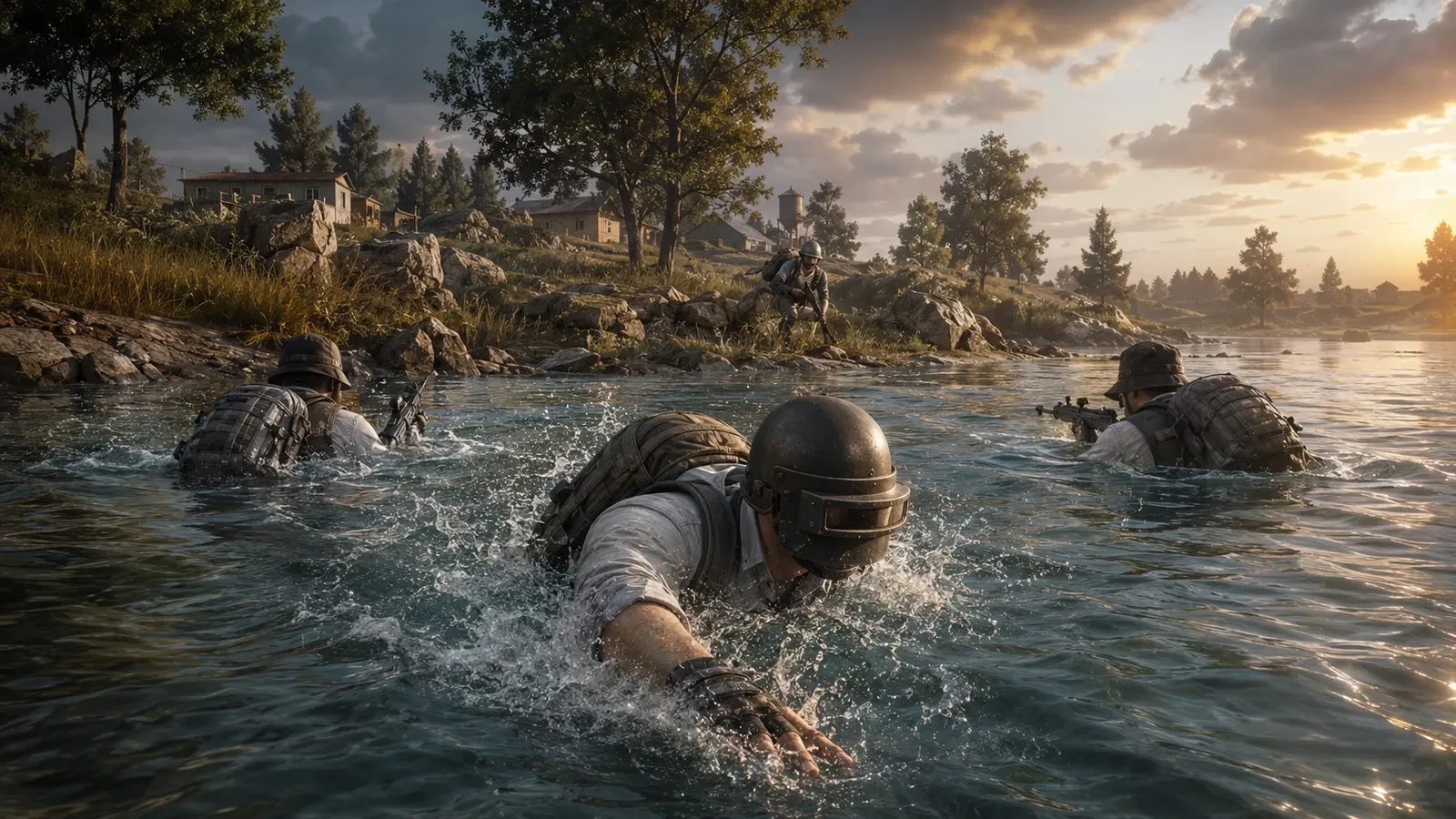
PUBG Mobile Version 4.5 changes an old rotation problem in a small but meaningful way. The official update adds Fast Swim, a directional dash that lasts for about 2.5 seconds before entering a cooldown. It does not turn every river into a safe highway, but it gives players a more deliberate way to cross exposed water, reach cover, and regroup with teammates.
This guide explains how to use that movement tool in Classic Mode without treating it like an automatic escape button. The best water rotation still begins with timing, scouting, route selection, and a clear shoreline plan. Fast Swim simply gives you another option when those decisions are already sound.
What Fast Swim Actually Changes
According to the official Version 4.5 update announcement, players can tap a new dash ability while swimming. The character moves in the current direction for roughly 2.5 seconds, after which the ability goes on cooldown. That simple description reveals the two most important rules: your facing direction matters, and the dash cannot be used continuously.
Fast Swim is therefore best understood as a burst of mobility rather than a permanent speed upgrade. It can shorten a dangerous portion of a crossing, help you adjust toward a better landing point, or close a small gap between squad members. It cannot replace a boat for long travel, guarantee a safe shore, or fix a crossing that begins too late.
The practical advantages
- Shorter exposure windows: A well-timed burst can reduce the time spent in the most open part of a river or channel.
- Better directional correction: If the original landing point becomes unsafe, the dash can help redirect toward nearby rocks, reeds, or lower terrain.
- Cleaner squad spacing: Slower teammates can use a burst to reduce separation without forcing the entire squad to stop.
- More confident final approach: Saving a dash for the last section can help you reach the shoreline and begin the climb sooner.
The limitation is just as important. Once the ability enters cooldown, you must continue swimming normally. If you spend the dash immediately and then discover danger at the shore, your strongest movement option may be unavailable when it matters most.
Decide Whether Water Is the Right Route
Before entering the water, compare the crossing with the available land route. Water may offer a direct line and fewer buildings, but it also limits how quickly you can change position. A slightly longer land rotation can be safer when it provides trees, ridges, compounds, or a vehicle.
Use the map, the playzone timer, and information from earlier engagements to make the choice. If nearby teams have already moved, a river can become a quiet shortcut. If the next zone forces several squads toward the same bridge or shoreline, the water may be predictable and heavily watched.
A quick pre-crossing checklist
| Question | Good sign | Warning sign |
|---|---|---|
| How far is the crossing? | Short channel with a clear exit | Long open stretch with no alternate shore |
| What is on the far side? | Rocks, low ground, trees, or buildings | Flat open bank or steep exposed climb |
| How much time remains? | Enough time to wait, scout, and regroup | Zone pressure forces an immediate entry |
| Where are nearby squads? | Their routes are known or they have moved away | Recent activity near the landing point |
| Is transport available? | No suitable vehicle or boat nearby | A safer vehicle route is ready |
A strong rotation is rarely the fastest line on the map. It is the route that leaves the squad with useful options after arrival. If the landing bank offers no cover and the next move is unclear, choose another route or delay until you have better information.
Choose a Landing Point Before You Enter
Do not start swimming toward a general area and decide later. Mark a precise landing point that every teammate can recognize. Good choices include a rock cluster, a dip in the bank, the back side of a small building, or a tree line that breaks direct sight from common approach routes.
Look beyond the water's edge. The first few seconds on land are often more important than the crossing itself. A shoreline may appear safe from the water while placing you below a steep slope with no quick route upward. Another bank may be easy to climb but completely exposed to a nearby compound.
Plan two exits
Set a primary landing marker and a nearby backup. The alternate should be close enough to reach without turning the crossing into a long detour. If the primary shore becomes unsafe, make one clear call and redirect together. Four players choosing four different exits creates more risk than the original threat.
Keep the backup on a similar line whenever possible. A large sideways change uses time and may separate the squad. Fast Swim can assist a modest correction, but it should not be expected to carry you across the width of the river after a late decision.
When to Use the 2.5-Second Dash
Because Fast Swim has a cooldown, timing is more valuable than simply activating it whenever available. The right moment depends on the length of the crossing and what you know about the far shore.
Option one: burst at the start
An early dash is useful when leaving the near bank is the riskiest part. This can happen when the squad must move away from an exposed beach or cross a short channel before an approaching zone. The drawback is that the dash may still be cooling down during the final approach.
Option two: save it for the middle
A middle burst works well for a moderate crossing when both shores have some cover. It reduces time in the widest, most open section while keeping normal swimming available for small adjustments near land. This is a balanced default when no immediate threat is visible.
Option three: hold it for the landing
Saving the dash for the final approach gives you the most flexibility. You can watch the shoreline, select the best angle, then accelerate toward cover once the exit looks clear. This is especially useful when the final few metres lead to rocks or low ground that can protect the squad during regrouping.
Avoid sharp direction changes during the burst. Set your camera and movement line first, confirm the destination, and then dash. A rushed input can carry you away from the intended exit and cost more time than it saves.
Use Squad Spacing Instead of a Single Cluster
A squad should not enter the same point in one tight group. Overlapping characters make it harder to read the shoreline, communicate changes, and choose clean climbing paths. At the other extreme, large gaps prevent teammates from supporting the same rotation plan.
Use a staggered formation with enough separation for clear movement while keeping every member on the same general route. One player can watch the destination before entering, two can begin the crossing, and the final player can follow once the first pair confirms the bank. This is a flexible pattern, not a rigid rule; zone pressure and terrain may require everyone to move sooner.
Assign simple roles
- Route caller: Places the primary and backup shoreline markers and makes the redirect decision.
- Lead swimmer: Tests the route and reports whether the landing geometry is easy to climb.
- Spacing player: Watches for a teammate falling too far behind and adjusts the formation.
- Rear observer: Checks the starting bank and announces movement from behind before entering.
Keep voice communication short. Calls such as “primary clear,” “shift left rock,” “hold dash,” or “regroup tree” are more useful than a long explanation during the crossing. The purpose is to give every teammate the same next action.
Approach the Shore at a Useful Angle
The shortest line to land is not always the best line. Aim for an angle that places cover between your squad and likely enemy positions. If a rock protects only its western side, approach from the water where that protected face becomes immediately usable.
Consider the climb animation and the terrain directly under the surface. Some banks let you transition smoothly from swimming to running, while steep edges can slow the exit. When time allows, choose a broad, low section of shore and use Fast Swim for the final approach. The first player should move past the waterline instead of stopping at the edge, leaving room for teammates to exit.
Do not sprint away alone
After landing, the squad should take nearby cover, check its surroundings, and regroup. The fastest swimmer can easily become separated if they continue deep inland while the others are still in the water. Hold a safe position that can observe the route without blocking the exit.
If the shore is unsafe, avoid several conflicting calls. Use the backup marker chosen before entry. A calm group turn is easier to execute than repeated left-right corrections, especially when teammates are at different points in the cooldown cycle.
Common Fast Swim Mistakes
- Using every dash immediately: This leaves no burst for a late shoreline adjustment.
- Entering without scouting: Faster movement does not make an unknown landing area safe.
- Aiming only at the closest bank: The nearest exit may lead into open ground or a difficult slope.
- Splitting across multiple destinations: Separate landings weaken communication and delay regrouping.
- Ignoring the zone timer: A long water route can still be costly even with short bursts.
- Following a vehicle route blindly: Boats and swimmers have different exit needs; choose terrain suitable for your actual movement method.
- Stopping on the shoreline: Move far enough to clear the exit for teammates and reach useful cover.
The safest way to learn the mechanic is through low-pressure practice. Use ordinary matches or suitable training opportunities to test the input, feel the duration, and understand how much directional change is comfortable. Avoid making your first serious experiment during a late-zone crossing.
A Simple Water-Rotation Routine
- Check the playzone timer and compare water, land, vehicle, and bridge options.
- Scout the far bank and nearby compounds from cover.
- Mark one exact landing point and one nearby backup.
- Agree whether the dash is for departure, mid-crossing, or final approach.
- Enter with controlled squad spacing and keep calls short.
- Face the chosen direction before activating Fast Swim.
- Adjust once if necessary; avoid repeated changes that split the team.
- Clear the waterline, take nearby cover, and regroup before the next rotation.
This routine makes Fast Swim part of a complete decision rather than a reflex. It also gives the squad a shared plan before movement becomes difficult to coordinate.
Final Takeaway
Fast Swim is one of Version 4.5's most practical mobility additions because it improves an action that appears on many Classic Mode maps. Its power comes from shortening selected moments of exposure, not from making water universally safe.
Use the dash with a clear destination, respect its cooldown, and save it for the part of the crossing that matters most. Combine it with a scouted shoreline, staggered squad spacing, a backup exit, and a disciplined regroup. When those basics are in place, water becomes a calculated rotation option instead of a desperate shortcut.
Top Up Your Favourite Games
If you're looking for a trusted place to top up your favourite games including Free Fire, PUBG Mobile, Mobile Legends, Blood Strike, and Call of Duty, visit HTGTopUp.com for fast digital game top-up services. Website: https://htgtopup.com.