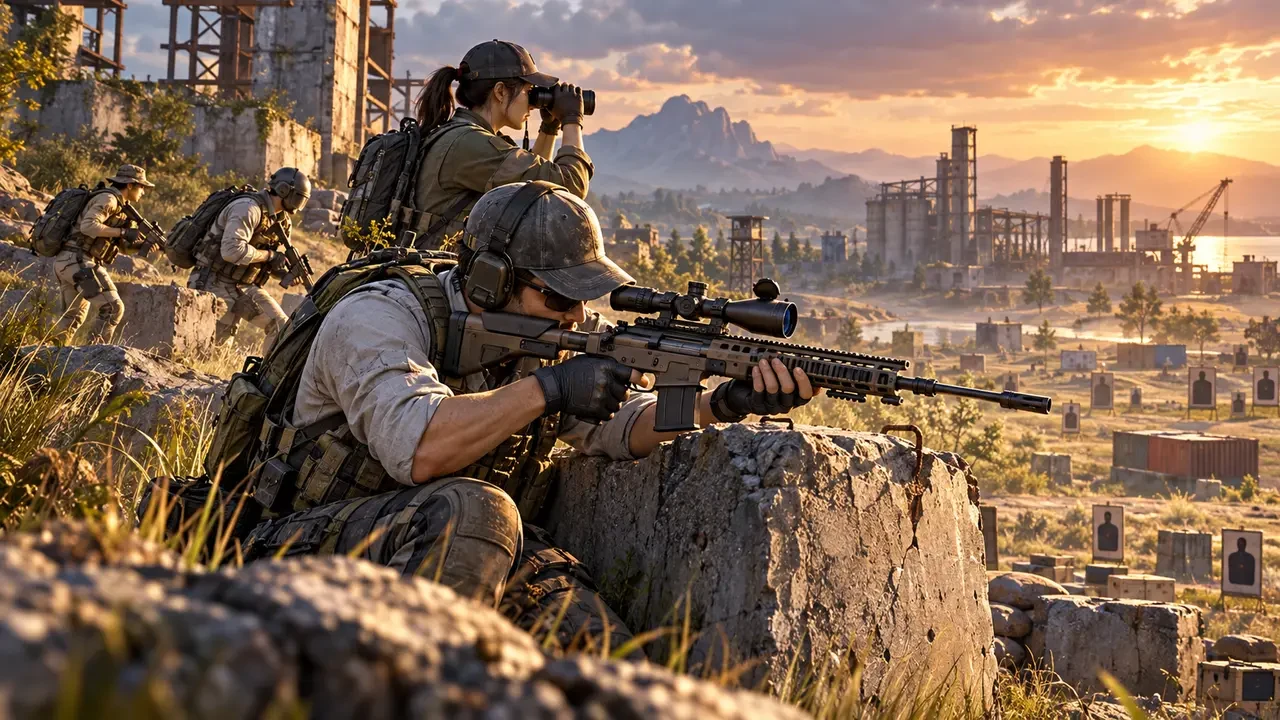
Designated marksman rifles sit between assault rifles and bolt-action sniper rifles in PUBG Mobile. They reward accurate repeated taps, controlled recoil recovery and good positioning rather than a single all-or-nothing shot. In a squad, a dependable DMR player can pressure enemies crossing open ground, punish exposed peeks and protect teammates who are rotating or reviving.
This guide focuses on skills that remain useful across balance updates: tap rhythm, crosshair recovery, cover peeking, scope control, ammunition planning and communication. PUBG Mobile officially provides Training Grounds for weapon practice, while its World of Wonder listings include target-training creations designed for AR, SR and DMR practice at different distances. That makes it possible to build a repeatable routine before entering ranked matches.
What Makes a DMR Different?
A DMR is built for controlled follow-up shots at medium and long range. Unlike a bolt-action rifle, it usually lets the player fire another round without leaving the sight picture for a manual cycling animation. Unlike an assault rifle used in automatic fire, it asks the shooter to manage each tap and allow the weapon to settle.
The important skill is not tapping as fast as the screen accepts. It is finding the quickest rhythm that still returns the crosshair to a predictable point. If the second and third shots climb away from the target, the extra speed produces noise rather than useful pressure.
Different DMRs can feel different because of recoil, bullet behaviour, magazine size, attachments and the ammunition used. Avoid memorising one rhythm for every weapon. Learn a method for discovering the correct rhythm whenever you change your DMR or loadout.
Choose the Right DMR Job for Your Squad
Before selecting a weapon, decide what the squad needs. The DMR player is not automatically the person who stays furthest behind. Good support depends on maintaining an angle that can quickly answer an enemy who challenges a teammate.
| Squad job | DMR priority | Positioning idea |
|---|---|---|
| Rotation cover | Accurate pressure on visible threats | Use a safe angle that overlooks the squad's path. |
| Knock confirmation | Fast, disciplined follow-up shots | Keep sight of the knocked player's nearby cover. |
| Enemy suppression | Repeatable taps without overexposure | Change peek timing so opponents cannot pre-aim you. |
| Scout support | Information first, damage second | Watch likely ridges, windows and vehicle routes. |
| Late-zone anchor | Ammo efficiency and survival | Preserve hard cover and avoid unnecessary wide peeks. |
A clear job also helps with scope and attachment decisions. A player guarding medium-range rotations may prefer faster target acquisition, while a long-range anchor may value a calmer sight picture. Build for the fights you expect rather than copying a class without context.
Master Tap Rhythm Before Speed
Start in Training Grounds with a stationary target at a comfortable distance. Place the crosshair on the same point and fire two shots. Watch where the sight settles after the first shot. Do not drag aggressively to force it back; first learn the weapon's natural recovery.
The three-stage rhythm drill
- Slow pairs: fire two deliberate shots and wait until the reticle clearly settles. Repeat until both land close together.
- Controlled triples: add a third shot while keeping the same spacing between taps.
- Progressive speed: shorten the pause slightly. Stop increasing speed as soon as the group begins to spread unpredictably.
Your useful fire rate is the fastest rhythm that remains accurate on the target size you expect in a match. It will change with distance. A close exposed opponent allows quicker taps, while a small head-and-shoulders target on a ridge requires more patience.
Practise releasing pressure as well as applying it. If the crosshair is no longer returning to the target, pause, reset and begin a new burst of taps. Continuing a lost rhythm wastes ammunition and reveals your position.
Control Recoil Without Overcorrecting
DMR recoil control is a combination of timing and small input. Pulling down too strongly can move the crosshair below the enemy between shots. Instead, use a light, consistent correction while the tap rhythm handles most of the recovery.
Test vertical control separately from horizontal inconsistency. If the group climbs in a clear line, adjust the downward input. If it spreads side to side, slowing the taps may be more effective than trying to chase every movement with the thumb.
Use a clean diagnostic target
- Fire one group without recoil correction to see the natural pattern.
- Fire a second group with gentle downward control.
- Compare the height and width of both groups.
- Change only one attachment or sensitivity setting at a time.
- Repeat from the same distance before judging the result.
This process prevents constant settings changes. A good configuration should be tested over several groups, not accepted after one lucky magazine.
Build Better Cover Peeks
Accuracy means little if the shooter remains exposed. A DMR player should begin each engagement from cover that protects most of the body and offers a route to another angle. Rocks, ridges, walls, windows and vehicles can all work, but damaged vehicles can become dangerous and should not be treated as permanent safety.
Peek, fire and return
Place the crosshair near the expected enemy position before exposing yourself. Peek only far enough to clear the cover, take a controlled shot or short sequence, then return. Avoid standing outside cover to admire the result.
Change the timing of the next peek. If you repeat at the same interval, an opponent can hold the exact spot and fire as you reappear. A short delay, a crouch variation or a move to another side of the same cover can break that prediction.
Do not fight every angle
If an enemy already has a stable sightline on your cover, disengage. Smoke, terrain and a teammate's pressure can create a safer reposition. Winning the match is more important than proving that you can repeat-peek a prepared sniper.
Scope Discipline and Target Tracking
High magnification helps identify distant details but narrows awareness and can make recoil feel more dramatic. Choose enough magnification to see the target clearly without losing control of the surrounding fight.
Before aiming down sights, centre the hip-fire crosshair near the expected target. This reduces the distance your scope must travel after opening. Once scoped, track the opponent's route rather than snapping at every sudden movement.
For a running enemy, begin with one measured shot to read movement and bullet travel. Adjust the next shot from the observed miss instead of rapidly sending several rounds to the same incorrect point. When the target reaches cover, keep your sight on the likely exit but communicate the location so teammates can watch alternate routes.
Use DMRs to Support, Not Isolate, the Squad
The strongest DMR angle is often one that overlaps with a teammate's fight. If the entry player makes contact, the DMR support should be close enough to punish the opponent who exposes themselves. A beautiful distant position is weak if terrain blocks every relevant trade.
Useful squad calls
- Direction and landmark: identify the ridge, window, tree or vehicle.
- Enemy count: report only what you have actually confirmed.
- Movement: state whether the enemy is crossing, holding or retreating.
- Damage state: call a knock clearly, but avoid claiming unverified damage.
- Your action: say when you are reloading, healing or changing angle.
Do not fill voice chat with every missed shot. Information should help teammates make a decision. “Two moving left from the red building; I am holding the rear player” is more useful than repeated calls of “enemy there.”
Manage Ammunition and Reload Timing
Repeated taps can consume ammunition faster than players expect, especially during a long ridge fight. Set an ammunition plan that leaves enough backpack space for healing and utility. Carrying excessive rounds can reduce the grenades and smoke needed to survive the final zones.
Reload behind cover, not immediately after every brief burst. A partially used magazine may still be enough to protect a teammate who is crossing. If the squad is about to move, announce the reload and complete it before leaving the position.
Ammo sharing also matters. If the DMR and a teammate use the same ammunition type, agree on minimum reserves. Do not collect every compatible round while the close-range player runs out during the next compound fight.
A 20-Minute DMR Training Routine
PUBG Mobile's official resources identify Training Grounds as a place to try weapons and practise shooting, and the official WOW listings include target-training creations for DMR work at multiple distances. Use either environment to make practice measurable.
- Minutes 1–4: stationary groups. Fire slow pairs and triples at near, medium and long targets.
- Minutes 5–8: rhythm changes. Find the fastest accurate tap rate at each distance.
- Minutes 9–12: moving targets. Track first, fire one measured shot, then correct from the result.
- Minutes 13–16: cover peeks. Pre-aim, expose briefly, fire and return. Vary the timing.
- Minutes 17–19: magazine discipline. Practise stopping a poor sequence, resetting and reloading safely.
- Minute 20: review. Note one problem to address next time rather than changing every setting.
Repeat the routine with the DMR you actually plan to use. Constantly changing weapons makes it harder to learn a stable rhythm, but occasional comparison helps you understand which platform best fits your squad role.
Common DMR Mistakes
Tapping at maximum speed
Fast input is not the same as effective fire. Slow down until the crosshair returns predictably.
Standing still outside cover
Long-range focus can create tunnel vision. Fire from protection, check other angles and reposition before opponents coordinate on you.
Using too much magnification
A large scope is not automatically better. Use a sight picture you can control at the engagement distance.
Chasing a knock alone
A knocked enemy may be protected by the rest of the squad. Confirm only when the angle is safe; otherwise maintain pressure and help your team advance.
Changing sensitivity after every miss
Misses can come from timing, movement, distance or poor positioning. Diagnose the cause before editing settings.
Final Match Checklist
- Choose a DMR and scope suited to the planned squad job.
- Confirm ammunition sharing before leaving the first loot area.
- Use a repeatable tap rhythm instead of uncontrolled speed.
- Pre-aim from cover and vary repeat-peek timing.
- Keep a trade angle on teammates rather than drifting too far behind.
- Communicate confirmed positions, movement and reloads clearly.
- Reposition when the enemy has prepared for your current angle.
DMR improvement comes from consistency. A player who lands controlled follow-up shots, protects teammates and survives each engagement offers more value than one who occasionally hits a spectacular long-range shot but repeatedly overexposes.
Top Up Your Favourite Games
If you're looking for a trusted place to top up your favourite games including Free Fire, PUBG Mobile, Mobile Legends, Blood Strike, and Call of Duty, visit HTGTopUp.com for fast digital game top-up services. Website: https://htgtopup.com.