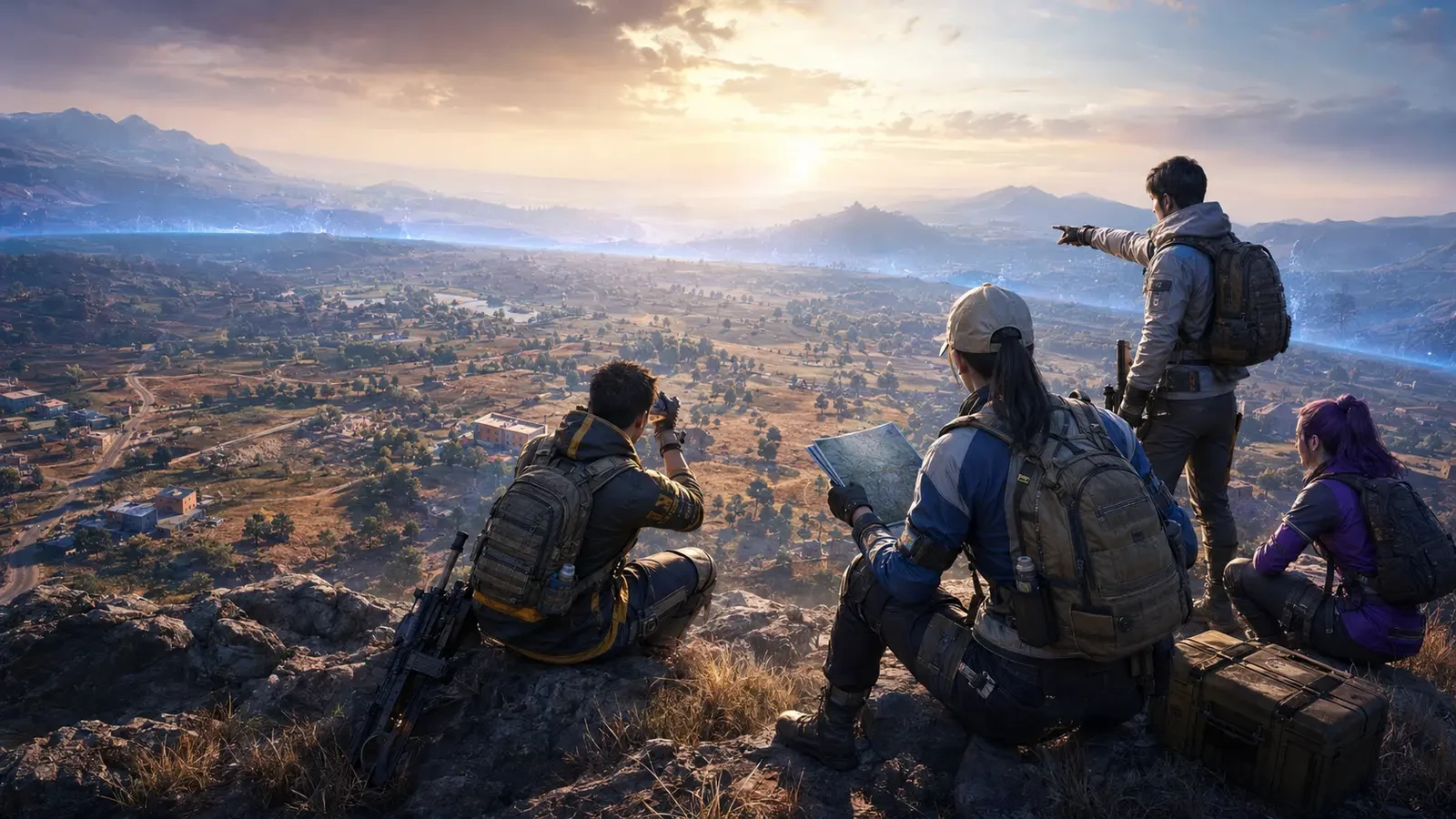
PUBG Mobile esports becomes much easier to follow when you stop watching only the elimination feed. The most important decisions often happen before two teams meet: choosing a drop location, collecting enough supplies, predicting the next safe zone, finding a route and deciding whether to hold ground or keep moving.
This viewer guide explains those decisions without depending on one tournament’s temporary standings. It is designed for PMWC, regional leagues and other official competitions where squads must balance survival, positioning and opportunities to earn eliminations across multiple matches.
Begin With the Tournament Format
Before the first match, check the official competition page for the stage, number of matches and qualification rule. A team’s correct strategy changes depending on whether it is playing an early group round, a survival stage or a final. A squad near the qualification line may value a stable placement more than an unnecessary early contest, while a team far behind may need to create more scoring opportunities.
The official Esports World Cup competition listing identifies PMWC as PUBG Mobile’s global event within EWC, while the PUBG Mobile Esports site remains the primary place for official competition information. For PMWC 2026, public tournament listings place the Group Stage in early August, followed by a Survival Stage and Grand Finals. Always recheck the official pages because schedules and match details can be updated.
Three questions to answer first
- Which stage is being played today?
- How many matches remain before qualification or elimination?
- Does the team need consistency, a comeback or only a safe finish?
Watch the Drop Before the Action
The opening flight path influences every team’s first decision. Squads prefer locations they have practiced, but an awkward route can increase travel time or encourage two teams to contest the same area. A contested drop can produce an early advantage, yet it can also damage both teams by slowing their looting and reducing their resources.
During the drop, observe how tightly the four players land. A compact formation supports quick trades and shared information. A wider split may collect supplies faster, but isolated players can be pressured before teammates arrive. Neither approach is automatically wrong; the right choice depends on nearby opponents and the squad’s plan.
Casters may call a location a team’s “home.” This usually means the squad is familiar with its loot routes, nearby vehicles and common exit paths. That knowledge can save time, which matters when the first safe zone appears far away.
Understand What the First Zone Reveals
The first circle does not decide the winner, but it creates the match’s traffic pattern. Teams outside the safe zone must choose routes inward. Squads already inside can take central ground, watch major roads or stay quiet on an edge. When many teams share the same route, a normally safe compound can become crowded.
Do not judge a rotation only by how far a team travels. Terrain matters more than distance. A short line across open ground may be more dangerous than a longer route using hills, ridges and buildings. Strong teams compare speed, cover, vehicle availability and the likelihood of meeting another squad.
Look for these broadcast clues
- Which side of the map has the most teams?
- Which bridges, roads or valleys could become bottlenecks?
- Which squads have central compounds or high ground?
- Which teams are still looting when others have already moved?
Central Play Versus Edge Play
A central team tries to occupy a position likely to remain useful through future circle shifts. The reward is less travel later, but the squad may be surrounded and unable to predict which direction pressure will arrive from. A good central position needs cover, clear information and disciplined use of resources.
An edge team works around the outside of the active zone. This can reduce the number of directions from which opponents can approach, but every new circle may force another move. Edge squads often need precise timing so they do not become trapped between the zone and teams holding the next layer of cover.
When the broadcast map appears, identify whether a team is central or on the edge. Then ask what its next problem will be. Central teams must defend space; edge teams must discover a route. This simple distinction explains many decisions that otherwise look slow or overly cautious.
Why Vehicles Matter Beyond Speed
Vehicles make long rotations possible, but their esports value is broader than transportation. They can help squads reposition quickly, carry supplies and create temporary cover in exposed late-game areas. At the same time, engine noise reveals movement, and a damaged or poorly parked vehicle can become a liability.
Watch whether a team preserves multiple vehicles or gathers everyone into one. A convoy gives more flexibility if one vehicle becomes unusable, while a single vehicle can keep the squad compact. Fuel, terrain and nearby opponents influence the decision.
Parking also reveals intent. A vehicle facing an exit suggests the squad expects to move again. Vehicles arranged around a weak position may be part of a defensive setup. When commentators praise “vehicle management,” they are usually describing preparation for a future circle rather than the drive itself.
Read Information Gathering as a Team Skill
Professional squads rarely move four players blindly into the same unknown space. One player may scout from a ridge while others remain protected. Another may hold the rear to prevent a surprise approach. The in-game observer will not always show every part of this setup, so use the minimap and team markers when available.
Good information answers practical questions: Is the next compound occupied? Can a vehicle cross the route? Is another team following? Which ridge blocks sight? A squad does not need complete knowledge. It needs enough reliable information to choose the lowest-risk route that still improves its position.
Signs of a controlled scout
- The player has a clear path back to teammates.
- The rest of the squad can respond if pressure arrives.
- The scout checks one route instead of wandering without purpose.
- The team moves soon after useful information is collected.
Separate Pressure From a Full Commitment
Not every exchange means a squad wants to finish a fight. Teams may apply pressure to protect a rotation, stop an opponent from crossing, gain information or force rivals away from valuable cover. If the position offers no safe way forward, a disciplined squad may disengage rather than extend the contest.
To understand the decision, count available players and check the zone timer. A team with all four members active but little time to move may prioritize the circle. A squad that has already secured safe ground can apply more patient pressure. The same exchange can therefore be correct for one team and wasteful for another.
Watch the spaces around the teams, not only the players themselves. A third squad approaching the area can turn a balanced engagement into a difficult escape. Experienced teams monitor this possibility and avoid staying fixed in one place for too long.
Evaluate Resource Management
Late-game strength depends on what a team carries into the final zones. Healing items support recovery, throwable utility helps teams create space, and enough ammunition allows sustained pressure. Broadcast inventories may not always be visible, but player behavior offers clues.
A squad using large amounts of utility during a minor edge exchange may have less flexibility later. A team that leaves a safe compound early might be searching for supplies or vehicles. When commentators mention limited resources, expect the squad to rely more heavily on terrain and timing.
Resources also include player health, vehicles and safe routes. A team with excellent loot but no protected path may still be in a weaker position than a lightly supplied squad already controlling the next ridge.
How to Read the Final Circles
As the playable area becomes smaller, every piece of cover gains value. A shallow ridge can hide movement, a small building can protect one angle, and a parked vehicle can block an otherwise open line. The best position is not always the geographic centre; it is the position that lets a team manage the greatest number of threats.
Count how many directions each squad must defend. A team protected by terrain on two sides can concentrate on the remaining approaches. A team standing on high ground may see more, but it can also be visible to several opponents. Position quality depends on both information and exposure.
Pay attention to teams that preserve four active players into the final phase. A complete squad can watch multiple angles, revive more safely and create coordinated movement. However, a smaller team with strong cover may still influence the result by staying hidden and choosing the right moment to act.
Use the Standings Without Overreacting
One excellent match can change a leaderboard, but tournaments reward performance across a series. When viewing standings, compare total results with the number of matches played and the stage’s qualification line. A temporary lead does not guarantee a final place, and a slow opening does not end a team’s chances if many games remain.
Look for repeatable qualities: reaching late zones with multiple players, avoiding unnecessary early losses, creating useful rotations and converting good positions. Those patterns are more informative than one dramatic finish.
| Broadcast moment | What to examine |
|---|---|
| Drop | Contests, team spacing and access to vehicles |
| First zone | Traffic routes, bottlenecks and early movement |
| Mid game | Cover, scouting, resources and squad health |
| Late game | Defended angles, remaining players and next route |
| Standings | Matches remaining, qualification line and consistency |
A Simple Viewer Routine for Every Match
Start by noting the flight path and any contested landing locations. When the first zone appears, identify teams facing the longest or most crowded rotations. During the middle game, watch one squad’s route from start to finish instead of switching attention only when the elimination feed changes.
In the final circles, count active players and protected angles. After the match, ask why the leading teams reached the end: Was it a central position, a patient edge route, preserved vehicles, good scouting or a timely move? This turns every broadcast into a practical lesson.
Use official tournament channels for schedules, results and format changes. Community summaries can help with analysis, but time-sensitive standings should always be checked against PUBG Mobile Esports or the official tournament organizer.
Final Takeaway
PUBG Mobile esports is a contest of information and timing as much as mechanical skill. Drops establish the opening plan, circles create traffic, vehicles enable options and terrain decides which options are safe. Once you learn to read those layers, quiet moments become meaningful and late-game decisions become easier to understand.
For PMWC 2026 and future tournaments, follow the official schedule, then watch each squad’s complete journey rather than only its final engagement. The route usually explains the result.
Top Up Your Favourite Games
If you're looking for a trusted place to top up your favourite games including Free Fire, PUBG Mobile, Mobile Legends, Blood Strike, and Call of Duty, visit HTGTopUp.com for fast digital game top-up services. Website: https://htgtopup.com.