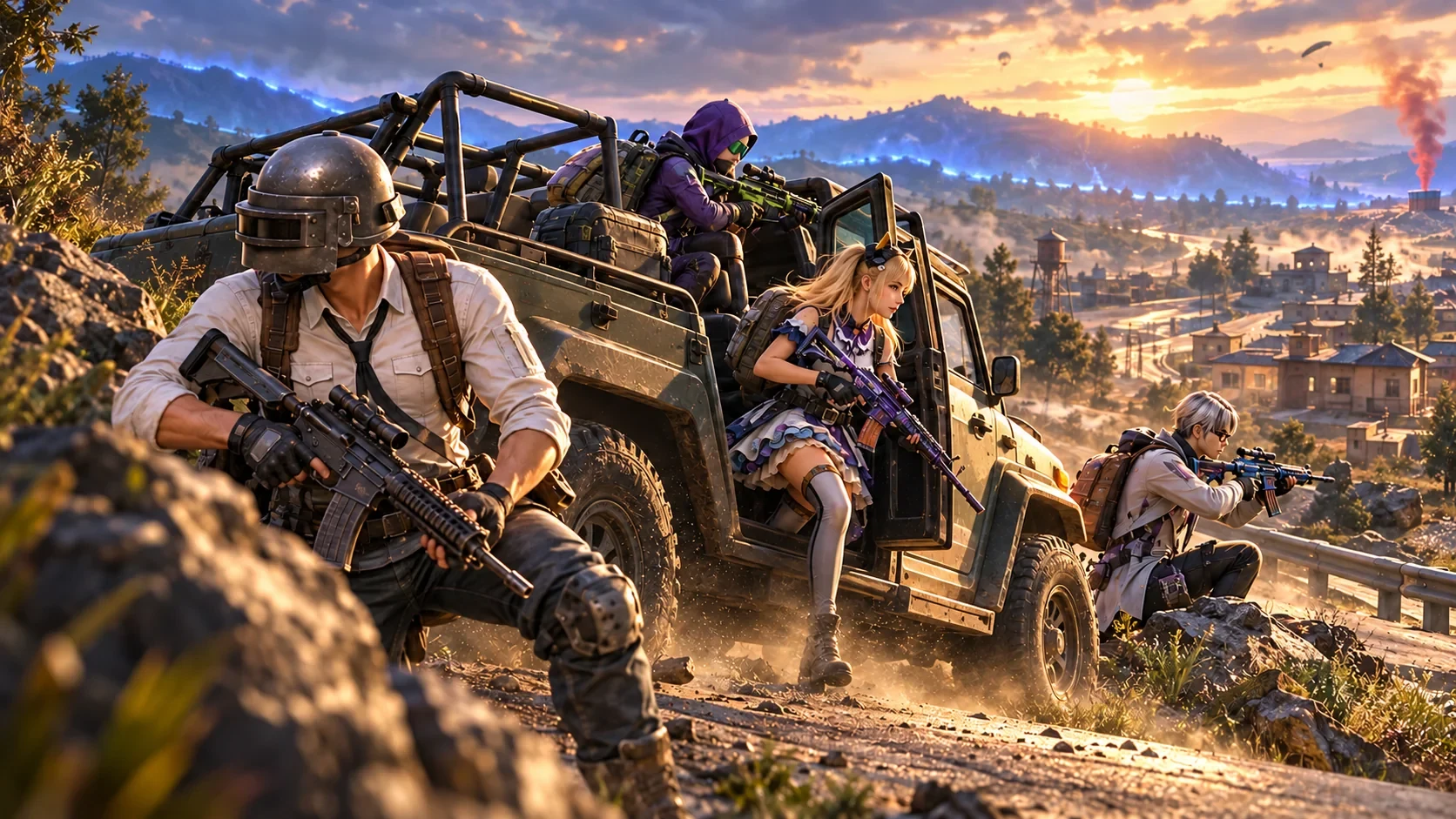
Vehicles can turn a difficult PUBG Mobile rotation into a controlled move, but speed alone does not make a rotation safe. A squad that drives without a route, spacing plan, or dismount call can arrive faster and still lose the fight before every player leaves the vehicle. The stronger approach is to treat the vehicle as part of a team system: choose a destination, read the ground around it, assign responsibilities, and know what to do if the first plan becomes unsafe.
This guide explains a repeatable method for route planning, convoy discipline, controlled dismounts, emergency recovery, and post-match review. It is written for classic battle royale squads and focuses on decisions that remain useful across maps and updates. Exact vehicle availability and terrain vary by map, so always confirm the current in-game conditions before applying any route.
Why Vehicle Rotations Need a Plan
A vehicle solves one problem: travel time. It does not automatically solve visibility, noise, exposed roads, fuel, blocked bridges, or the danger of stopping beside an occupied compound. In fact, a loud approach can reveal your squad to several teams at once. The goal is therefore not to stay in the vehicle for as long as possible. The goal is to use it for the portion of the rotation where its speed creates more value than its noise and predictable path create risk.
Before moving, agree on three points: the intended destination, a fallback destination, and the side from which the squad wants to approach. This small briefing prevents the driver from making every choice alone while passengers discover the plan only when the brakes are applied.
- Primary destination: the compound, ridge, low ground, or hard cover the squad wants to occupy.
- Fallback destination: a safer position that can be reached if the primary route is watched or blocked.
- Abort trigger: a clear reason to keep driving, such as multiple vehicles, open doors, active gunfire, or enemies already holding the arrival angle.
Build a Route with Three Layers
Layer 1: The fast line
The fast line is the shortest practical path toward the next playable area. It is useful when time is limited, the blue zone is close, or the squad already has reliable information about the road ahead. Its weakness is predictability. Major roads, obvious bridges, and direct entries are easy for opponents to watch.
Layer 2: The covered line
The covered line sacrifices some speed to move behind hills, tree lines, dips, or buildings. It may involve leaving the road early and using terrain to hide the final approach. This is often the best default when the squad has enough time because it reduces the number of angles that can see the vehicle at once.
Layer 3: The escape line
The escape line is not necessarily a marked route. It is the direction the driver will take if the destination is occupied or the vehicle receives heavy damage. Good drivers look for turning space, downhill momentum, hard cover, and a second stopping point before committing. A dead-end courtyard or steep rock face may look safe on the map but leave no recovery path.
Assign Roles Before the Engine Starts
Clear roles reduce confusion during the noisiest part of a rotation. They do not need to be permanent player identities; they only describe who owns each task for the next move.
- Driver: controls speed, route changes, vehicle orientation, and the final stop. The driver should announce sharp turns, planned exits, and any abort.
- Navigator: watches the map, zone timing, route options, and possible choke points. This player gives short directional calls rather than continuous commentary.
- Forward scout: watches the destination and early danger signs, including parked vehicles, open doors, movement, and muzzle flashes.
- Rear guard: checks pursuit, remembers the previous fight, and warns when another vehicle follows the same line.
The driver should still make immediate steering decisions. The navigator provides information, but two players fighting for control of the route creates hesitation. Use compact calls such as “primary clear,” “fallback left,” “do not stop,” or “dismount right.”
Choose the Right Moment to Leave the Vehicle
A safe dismount begins before the vehicle stops. Passengers should identify the nearest hard cover, avoid stacking on one door, and know whether the squad is fighting or simply breaking contact. Stopping directly at the centre of a compound can surround the team with windows and doorways. Stopping slightly short, behind a wall, ridge, rock, or terrain fold often gives the squad time to gather information.
When possible, park so the vehicle itself blocks the most dangerous known angle without trapping every player on the same side. A sideways vehicle can provide temporary cover, but it also creates a narrow line that grenades and crossfire can punish. Spread to separate pieces of cover as soon as the situation allows.
A simple dismount sequence
- The driver announces the stop side and whether the squad will fight, hold, or continue moving.
- Passengers look toward assigned sectors instead of all watching the same building.
- The squad exits toward cover, not toward open ground simply because that door is closest.
- One player watches the likely enemy angle while another checks the vehicle and escape route.
- The team confirms all four players are ready before pushing away from the landing point.
Hard Stop, Rolling Exit, or Drive-Through?
Not every arrival needs the same technique. Use a hard stop when the destination has reliable cover and the squad intends to hold it. Reduce speed before the final turn so passengers can read the area and exit in control.
A rolling exit is useful only when players understand the risk and the vehicle is moving slowly enough for the situation. The purpose is to avoid bunching at one exact point, not to scatter the squad across open ground. If terrain, damage, or enemy fire makes the timing uncertain, prefer a controlled full stop.
A drive-through is the correct call when the first look reveals danger that outweighs the position. Signs include several opponents already aiming at the road, a vehicle blockade, no usable cover, or a stop that would place the squad between teams. Do not turn an obviously bad entry into a forced fight merely because it was the original plan.
Convoy Discipline with Two Vehicles
Two vehicles give a squad redundancy, but they can also split the team. Avoid driving side by side through narrow roads because one obstruction can trap both vehicles. A short stagger is better: close enough to help, far enough that the second driver can react to an ambush or blocked route.
Agree which vehicle leads. The lead vehicle reads the route; the trailing vehicle watches the rear and should not overtake without a call. At the destination, the vehicles should not park so closely that one explosive threat controls both. If one vehicle becomes disabled, the second driver must decide whether a pickup is possible without stopping in the same danger area.
- Keep voice calls focused on turns, contact, damage, and destination changes.
- Avoid unnecessary horn use or visual signalling that adds noise without information.
- Do not allow the convoy to stretch so far that the rear pair cannot join the next fight.
- If separated, use a safe rally point rather than ordering an exposed U-turn.
Fuel, Damage, and Vehicle Health Checks
Before a long move, the driver should check whether the vehicle can complete the route and still support a fallback. A low-resource vehicle may be enough to cross one exposed field but not enough for a second rotation. Likewise, a badly damaged vehicle should not be treated as dependable hard cover.
Make the check while the squad is looting, not after the zone begins moving. If the vehicle is weak, shorten the planned route, identify a replacement opportunity, or use it only to cross the most dangerous open section. Passengers should avoid firing without purpose from a moving vehicle because noise can attract attention and make it harder to identify the squad’s actual destination.
Recover from an Ambush
When shots land, the first question is whether stopping improves the squad’s odds. If the attackers have elevation, prepared cover, and a clear view of the road, braking in the open usually gives them exactly the fight they wanted. The driver should use terrain, change the angle, and reach cover before the team returns fire.
If the vehicle cannot continue, call a single dismount side, spread behind separate cover, and account for every teammate. Smoke can help break a sightline, but it should support movement toward real cover rather than become the squad’s only protection. Revives should begin only after someone is watching the enemy angle and the rescue position is not exposed to an easy push.
After surviving the first burst, avoid immediately peeking from the same rock or vehicle edge. Opponents will often hold that angle. Reposition, identify whether the attackers are chasing, and decide whether the squad is defending, disengaging, or counterattacking.
Practise the System in Short Drills
Vehicle coordination improves faster when the squad practises one skill at a time. In lower-pressure matches or training sessions, select a route and repeat the same arrival with different stop positions. Compare how quickly every player reaches cover and how many angles the team can watch.
- Thirty-second briefing: name the primary, fallback, approach side, and abort trigger.
- Four-sector exit: each player leaves with a different observation responsibility.
- Blocked-route drill: the navigator calls a fallback before the driver reaches the obstacle.
- Disabled-vehicle drill: the squad spreads, establishes cover, and chooses fight or disengage.
- Two-vehicle rally: practise regrouping without parking both vehicles in one vulnerable location.
The official PUBG Mobile site remains the safest starting point for current game access, announcements, security resources, and support links. Check official channels when map content, modes, or mechanics change rather than relying on an old route assumption.
Review Every Rotation with Five Questions
A useful review is short and specific. The squad does not need a complete replay analysis after every match. Focus on the decision that created the outcome.
- Did we leave with enough time to choose a covered route?
- Did every player know the primary and fallback destination?
- What information told us the arrival was safe or unsafe?
- Did the stop place players beside usable hard cover?
- Could the driver have preserved a better escape line?
If the answer reveals a repeated problem, change one rule for the next session. For example, leave twenty seconds earlier, stop outside compounds until a scout checks windows, or assign a navigator before every vehicle move. Small, measurable changes are easier to apply than vague instructions to “rotate better.”
Final Vehicle Rotation Checklist
- Confirm primary destination, fallback, approach side, and abort trigger.
- Check time, fuel, damage, turning space, and possible choke points.
- Assign driver, navigator, forward scout, and rear guard.
- Plan the stop around hard cover and a usable escape line.
- Call the dismount side before braking.
- Spread to separate cover and watch different sectors.
- Drive through an obviously trapped arrival instead of forcing the original plan.
- Review one decision after the match and carry one improvement forward.
Strong vehicle play is not about the most aggressive driver or the fastest road. It is about arriving together, preserving options, and turning movement into a position the squad can actually defend.
Top Up Your Favourite Games
If you're looking for a trusted place to top up your favourite games including Free Fire, PUBG Mobile, Mobile Legends, Blood Strike, and Call of Duty, visit HTGTopUp.com for fast digital game top-up services. Website: https://htgtopup.com.