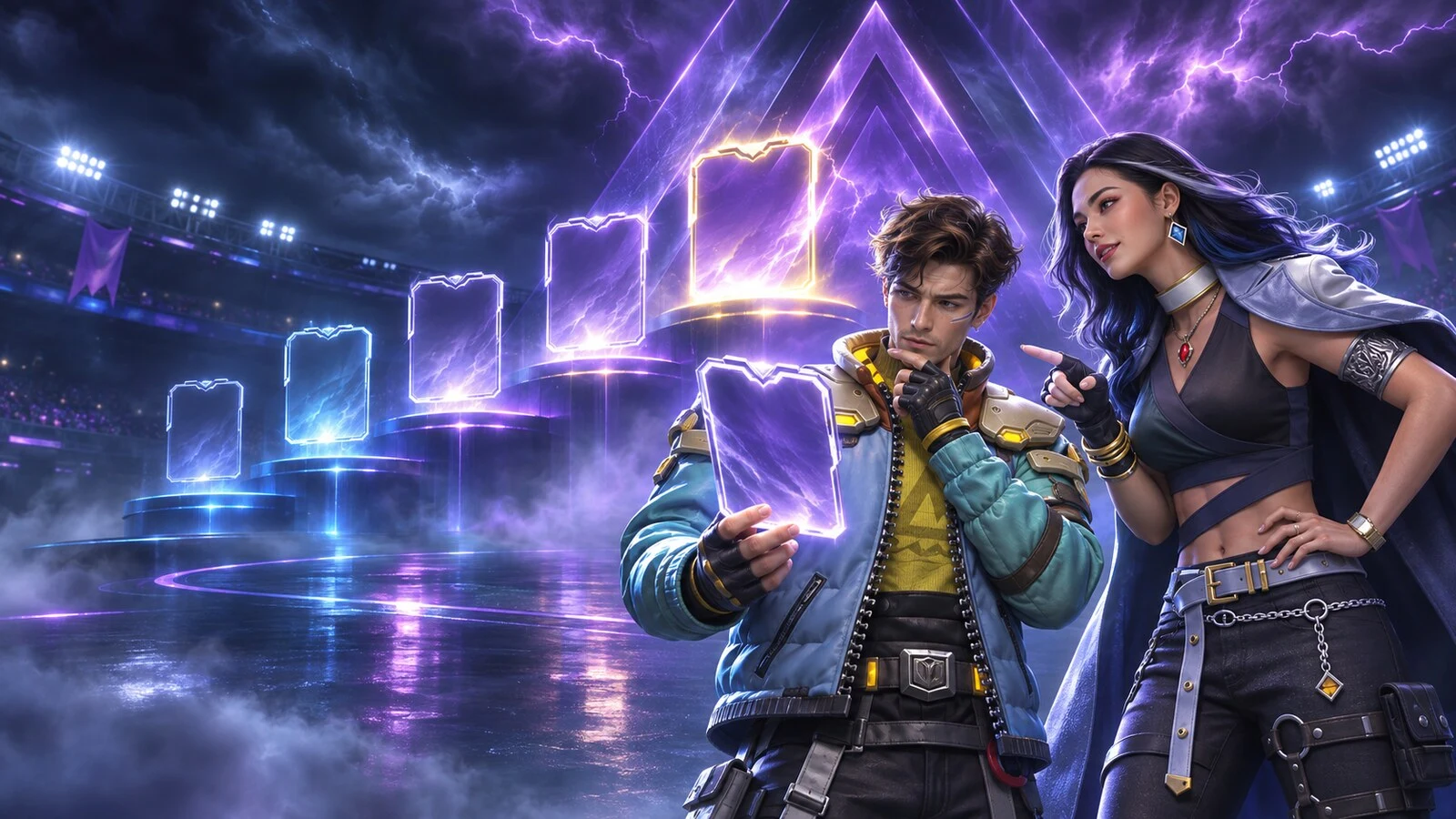
Free Fire’s Storm Arena campaign gives every match a second story to tell. Alongside the usual fight for survival, players can build Storm Reputation through match performance and develop a personalised Player Card. The system is connected to the Free Fire World Series Global Finals 2026, but you do not need to follow every tournament result to understand it.
This guide separates confirmed features from sensible playing habits. Garena has named the five Player Card stages and described the types of highlights and customisation they can include. It has not published a universal points table or exact thresholds in its English announcement. Always treat the current in-game event panel as the final source for live requirements.
What Storm Reputation Actually Does
Garena launched Storm Arena on 6 November 2026 as the in-game campaign accompanying the FFWS Global Finals in Bangkok. Its theme is progression toward a player’s “prime,” represented by a Player Card that develops as Storm Reputation increases.
The official campaign announcement says reputation comes from match performance. It also confirms that Player Cards can present performance highlights, medals and achievement statistics. That makes the card more than a decorative frame: it is designed as a compact event profile that can reflect how you have played during the campaign.
However, the announcement does not define which action is worth a particular number of points, whether every mode is weighted equally, or whether all players receive identical tasks. Do not rely on screenshots, old regional posts or a friend’s progress bar as proof of your requirements. Open the event page in your own game client before starting a session.
The Five Confirmed Player Card Stages
Storm Arena uses five named stages. They form a clear visual ladder, but the names should not be mistaken for ranked tiers or promises of a particular reward. The stages confirmed by Garena are:
- First Time: the opening stage of the event journey.
- Big Time: the second step as your Storm Reputation develops.
- Show Time: the midpoint of the five-stage sequence.
- Peak Time: the stage immediately before the final level.
- Prime Time: the fifth and highest named Player Card stage.
Garena says upgrades can introduce richer animations, celebration poses and localised caster voice lines. It does not state in the public English article that every cosmetic element is granted at a fixed stage for every account. Check the card preview and unlock labels inside the event rather than assuming a feature arrives at a specific milestone.
Progress is not the same as rank
Your ranked tier and Storm Reputation are separate ideas. Ranked play measures competitive progress under the game’s ranked rules, while Storm Reputation belongs to the Storm Arena campaign. A strong ranked result may also be a good performance, but it should not be treated as proof of a particular reputation gain unless the event screen confirms it.
A Reliable Routine Before Every Match
The most efficient approach begins before matchmaking. Spend one minute reading the live event page, then build your session around confirmed tasks instead of guessing what the campaign wants.
- Check the active mode: confirm whether the displayed objective applies to Battle Royale, Clash Squad or another listed queue.
- Read the progress wording: notice whether the task asks you to play, survive, win, achieve a result or complete a different action.
- Record the starting value: a quick screenshot helps you compare progress after the match without relying on memory.
- Finish valid matches: leaving early can make it difficult to judge whether an action counted.
- Reopen the event panel: let the client display the updated value before planning the next match.
This simple check-and-review loop is safer than grinding for hours based on an unverified social post. If progress does not update, confirm your connection, mode and task conditions before repeating the same action.
Build Better Match Performance Without Chasing a Hidden Formula
Because Garena describes Storm Reputation as performance-based without publishing a complete formula, the sensible goal is to play useful, repeatable Free Fire. Do not sacrifice the match merely to chase one flashy statistic that may not be part of the calculation.
In Battle Royale
Choose a landing plan your squad can execute. Looting efficiently, sharing resources, rotating before routes become crowded and taking fights with usable cover all support consistent performance. If the event panel names a specific objective, complete it without abandoning survival and team coordination.
Late-game discipline matters to the match even when the reputation formula is unknown. Keep track of safe-zone timing, remaining utility, squad spacing and possible third parties. A rushed engagement can erase ten minutes of good preparation; a patient rotation can preserve several options.
In Clash Squad
Clash Squad rewards round-by-round adaptation. Buy for a clear role, communicate enemy positions, trade with teammates and avoid isolated challenges. Review what changed after a lost round rather than repeating the same opening.
Storm Arena brings themed experiences to both Battle Royale and Clash Squad, according to Garena. That does not mean both modes always have identical reputation conditions. Use the current event label to decide where your time belongs.
Use the Player Card as a Review Tool
A Player Card can show performance highlights, medals and achievement statistics. Instead of treating it only as a status symbol, use it as a prompt to review patterns in your play.
- Compare recent highlights with the role you intended to play.
- Look for consistency across several matches, not one exceptional moment.
- Ask whether your statistics reflect team contribution as well as individual fights.
- Set one practical improvement goal for the next session.
For example, an aggressive player might focus on choosing cleaner engagements, while a support-focused teammate might improve positioning for faster trades. The card is most useful when it starts a review, not when it becomes a reason to force risky plays.
For the tournament context behind the campaign, read HTG Digital’s FFWS Global Finals 2026 viewer guide. It explains the event stages and how Storm Arena connects players to the competition without inventing live results.
Customise Without Losing Track of Requirements
Garena confirms that Player Cards support team badges, poses and decorations. These choices let you build a profile around a favourite team or visual style while the staged card provides the campaign’s progression layer.
Start with the elements already marked as available on your account. Preview a combination before saving it, then check whether a locked item has a stated requirement. Availability can depend on event progress, the current client, region or campaign timing, so avoid promising another player that a decoration is guaranteed.
The announced localised caster voice lines cover eight languages: Thai, Indonesian, Vietnamese, Malay, Hindi, Bengali, Arabic and Portuguese. Sinhala and Tamil were not included in Garena’s English announcement. Sri Lankan players should choose from the options actually shown in their client rather than downloading unofficial audio files.
A Practical 20-Minute Storm Reputation Session
A short, focused session can be more useful than an unfocused grind. Try this structure when you have limited time:
- Minute 1–2: open Storm Arena, read the active conditions and note your current reputation or stage.
- Minute 3–5: choose the correct mode, confirm your loadout preferences and agree on a squad plan.
- Minute 6–17: play the match with the event condition in mind while protecting the team’s main objective.
- Minute 18–20: check updated progress, review one decision and adjust your next session.
A Battle Royale match may take longer, and queue times vary, so treat the timing as a planning example rather than a delivery guarantee. The important pattern is to verify, play and review.
Example Scenario: A Squad Avoids Wasted Matches
Illustrative example — not a real testimonial: A four-player squad opens Free Fire after seeing a post that claims eliminations are the only way to earn Storm Reputation. Before queuing, one player checks the event panel and finds that the current displayed condition on that account requires a different form of participation.
The team changes its plan, selects the mode named in the panel and takes a screenshot of the starting progress. During the match, it plays normally instead of sending every teammate into separate fights. After the result screen, the players reopen Storm Arena and compare the updated value.
The lesson is not that one particular condition always applies. It is that the live client prevented the squad from wasting matches on an unsupported claim. The same verification habit works whenever events, regions or account progress create different screens.
Protect Your Account From Fake Event Offers
High-profile campaigns attract fake reward links, imitation livestreams and messages that promise instant reputation. Use the in-game event hub, Garena’s official Free Fire website and verified official channels for campaign information.
- Never share your game-account password, social-login password or one-time code.
- Do not install unofficial files claiming to unlock a Prime Time card.
- Do not pay a stranger to “boost” event progress on your account.
- Check the web address before signing in or following a reward link.
- Keep receipts for legitimate purchases and contact the relevant support channel if something goes wrong.
A Player Card is not worth surrendering control of your account. Real event progress should be visible through the official game client.
Storm Reputation FAQ
Does Garena publish fixed points for every action?
Not in the public English Storm Arena announcement used for this guide. It says reputation is earned through match performance but does not provide a complete action-by-action formula. Follow the live event panel.
Are First Time and Prime Time ranked tiers?
They are the first and fifth named stages of the Storm Arena Player Card sequence. Do not treat them as replacements for Free Fire’s ranked tiers.
Can I choose any language for caster voice lines?
Garena announced eight localised languages. Your actual options should be confirmed in your client, because language and feature availability may vary.
Are every pose and decoration permanent?
The announcement confirms customisation features but does not give a universal permanence rule for every item. Read each item’s in-game description and any displayed expiry information.
Will paying for diamonds automatically increase Storm Reputation?
Garena describes reputation as coming from match performance. Do not assume a purchase changes it unless the official event screen explicitly states a relevant condition.
Make Every Stage Meaningful
Storm Reputation works best when it encourages a more deliberate session. Check the official requirements, play the correct mode, contribute to your squad and review progress after the match. The five stages give the campaign a visible direction, while the Player Card provides space for highlights, medals, statistics and personal style.
Keep expectations grounded. Garena’s announcement confirms the system’s main features, but the live game client controls current tasks and availability. That distinction helps you progress without relying on invented thresholds, reward claims or rumours.
Top Up Your Favourite Games
If you're looking for a trusted place to top up your favourite games including Free Fire, PUBG Mobile, Mobile Legends, Blood Strike, and Call of Duty, visit HTGTopUp.com for fast digital game top-up services. Website: https://htgtopup.com.